Qu’est-ce que Montpellier?
What is the city? What is Montpellier? I want to describe what Montpellier is for me, but to do that I first must tell you what I think the city is. Arguably the city is the crowning achievement of our over 40 thousand years of civilization; and, for me, Montpellier is one of her crown jewels. Note I said the city – not a city – in order to distinguish the concept of the city, the idea, from the mere descriptor of a population center with a particular polity and a certain density of population and development.
The city began before recorded history wherever groups of our socialized, peripatetic species crossed paths with one another. Those crossing points were the nucleus, and the communities that developed from the interchanges between those groups of travelers were the embryos of the city. As they grew they became hamlets, then villages, then towns (remnants of these remain as part of the names) and finally, when the complexities of life mandated political organization, the cities more and more of us find ourselves living in.
Montpellier, which just celebrated its 1,038 birthday, is one of the younger ones, a mere teenager compared to Marseille, founded around 600 BCE, or Paris, founded a little over 300 years later, and they are mere babes compared to say, Damascus that dates back as far as 10,000 BCE.
The city is a living thing. Like all living things it has many parts, many systems that work together in order to live. We, human beings, her citizens, are her lifeblood, without us she dies. But for us to live in her, and for the city to live and thrive, we must strive to live together harmoniously. But mostly because we are human, we too often seem to be incapable of achieving that degree of harmony necessary for our that without imposing upon ourselves certain rules and customs which is where politics becomes necessary. Instinctively we crave a certain degree of order; and to achieve it most of us most of the time are willing to surrender some amount of our freedom to do as we will. Without that willingness to surrender some of our freedom in exchange for achieving an acceptable level of order the city cannot exist, much less survive.
For me Montpellier is one of those cities that has been able to achieve that balance, that level of order, to a remarkable degree. I am finding here that level of harmony that allows over 500,000 thousand people from all over the world – from Russia and Ukraine, from Pakistan and India, from Kenya and Uganda, from Tunisia and Morocco, from England, Sweden, Germany, and France, even from the United States – live close together without the undercurrents of barely suppressed hostility that I found was too often the case in the United States.
In Montpellier, if you’re not French (as I am finding many of us are not) you have made a choice to live here as the French do. The lubricant of common courtesies, the ”Bonjours”, the “Bonne journées”, are exchanged sincerely, making everyday life move without stress. Exchanges of smiles are common both when crossing Comédie and negotiating the narrow sidewalks. Even when there is discord, and there is protest (below, upper left) it usually has a somewhat festive quality about it. The structure in the background is La Tour de la Babote, the remains of the wall that was built in the 12th century around Montpellier and was later used as an astronomical observatory.
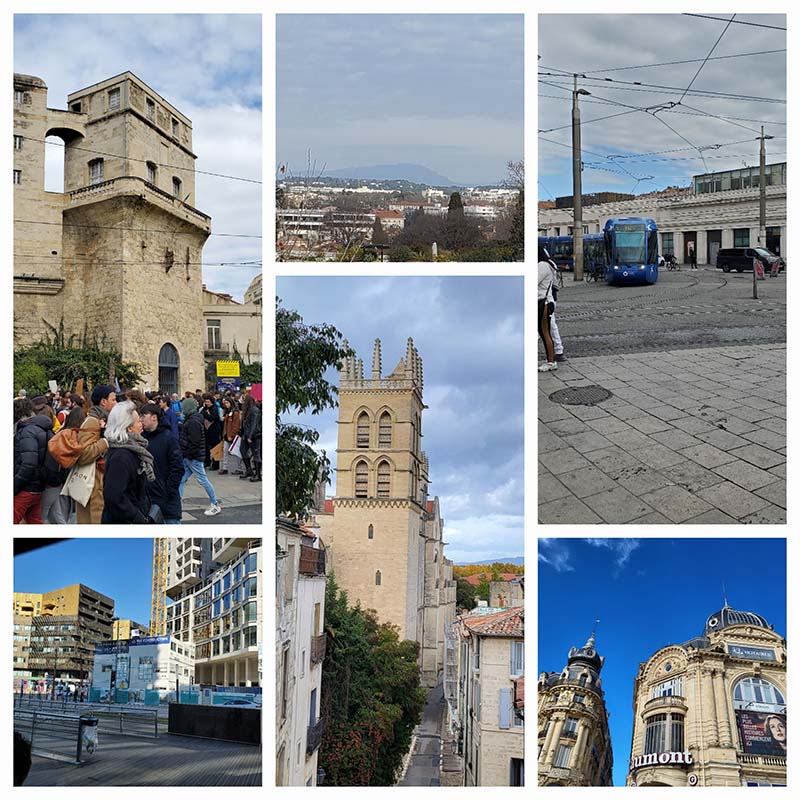
Comédie is a large pedestrian plaza at the eastern edge of Montpellier’s oldest neighborhood, L’Ecusson, that is at the top of the hill that put the “Mont” in Montpellier, and is a major meeting place in the city above a four-level underground garage, and bordered by fin de siècle buildings (above, lower right) on the west, and Triangle-Polygone-Galleries Lafayette to the east, which leads into Antigone and beyond, the River Lez. On the west side of Comédie Rue de la Loge connects to Rue Foch, and then at Place Martyrs de la Resistance to Rue Foch that ends at the western edge of L’Ecusson at the Arc de Triomphe, and Promenade du Peyrou, with its views of the Cevennes to the north (above, top center) the Aqueduc Saint-Clement and the Les Arceaux neighborhood it passes through.
We live on the south side of L’Ecusson in the heart of the Gambetta neighborhood where Avenue Georges Clemenceau meets Avenue de Toulouse at Place du 8 Mai. Tying all these neighborhoods of Montpellier together is the tram system, built and operated by the Transports de l’agglomération de Montpellier, better (and thankfully) known as TaM here (above, upper left) whose four tram lines and 28 bus lines connect them to one another and to both gares (train stations) and the airport. Ridership is high, and beginning this month it is free to all Montpellier residents.
Virtually everyone in Montpellier lives just a short walk from a boulangerie, a marché, a pharmacié, and anything else you might want is almost as close. We are using a laverie that we go to and from by bus. We choose to go there, not because it is the closest, but because it is the cleanest and has a nice folding table. There’s also a café nearby, so we don’t have to stare at the clothes going around and around.
We’ve been here now for over 45 days, and I’ve probably walked more miles in that time than we would have walked in a year in the United States. I hope I’ve given you at least a hint as to why I love living here. The walking the Jardin de Plante, the Zoo de Montpellier, but mostly it is the people here that fascinate me, and make the most ordinary things extraordinary adventures.
À bientôt!
-John & Bonny
 La Vie de Montpellier
Leave a comment