(Also known in Montpellier as Avenue Georges Clemenceau)
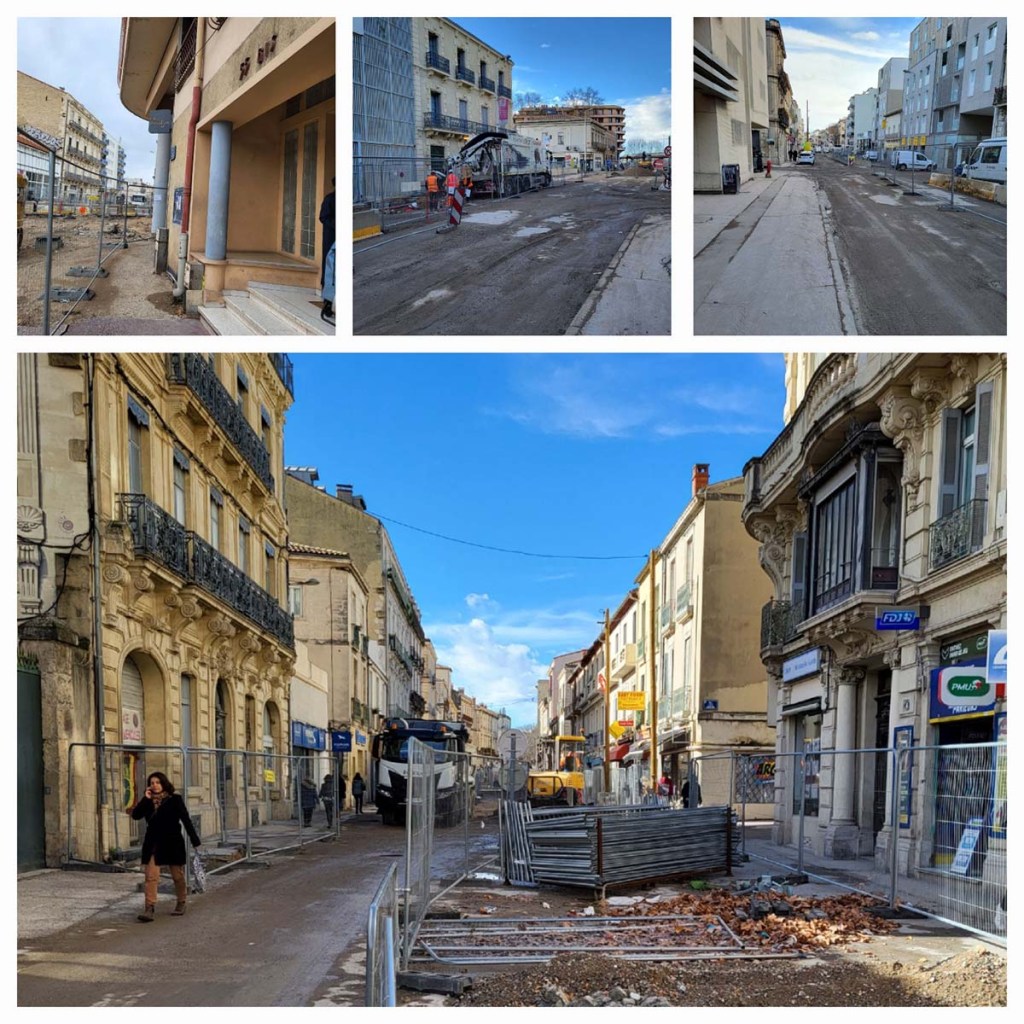
Clockwise from top left: 1. the entrance to our building 2. looking back toward our building at 55 bis Ave. Georges Clemenceau 3. looking up toward Cour Gambetta 4. looking down Ave. Georges Clemenceau from Cour Gambetta
The name of a mysterious place in Greek mythology – also known as Elysium – (for you fans of J. S. Bach’s Ninth Symphony’s fourth movement, especially its ) – where in Greek mythology, the souls of heroes and those who lived virtuous lives are sent to live after death. It is also a metaphor for any place living people find to be an extremely nice place to live.
Avenue Georges Clemenceau is a major construction zone for the TaM system’s Ligne 5 coming to completion at the end of 2025. Do the math and comprehend that calling it “Elysium” is a bit tongue-in-cheek. At least on weekends we don’t need to watch out for behemoths doing their jobs, just fancy footwork tip-toeing through the detritus of progress. On one hand, as a sidewalk superintendent from way back, I (moi) thoroughly enjoy it – I find it entertaining to observe from our eyrie – but on the other hand, we are more than moi, and nous find it somewhat less than elysian, especially when it is raining, or during the day when there might be géants.
Consequently (Par consequent) 55 bis may not be our final “resting place” in Montpellier. Should (or more likely, when) that happens we’ll let you know.
Meanwhile…
The following is a brief editorial note from the publisher. Usually when you see something like this it means that the publisher has decided to make some publishing changes, or more often, a raise in prices. Since the cost to you has been zero, it cannot possibly be the latter.
But after some twelve odd issues, the writer and the editor (who are also the publisher and the circulation department) have decided to attempt to bring order out of chaos. Instead of being published at random, we have decided to publish once a month, beginning with this March issue.
So, this will be Fascicle une de Livre II de La vie à Montpellier. Each issue, much like this one, will mostly focus on the previous Month, and try not to repeat themes from the past, unless brought by popular demand. This will allow the editor to check the writing of the writer for errors in spelling (bonne chance) grammar (très bonne chance aussi) and/or fact. The editor also hopes this will lower the readers’ exposure to the writer’s more extreme flights of fancy – and to possibly less complex sentences, even if it is only to remind him that his job is to communicate, not bloviate. So relax, there will be no increased costs for you to receive your future editions, and all of us here at La vie à Montpellier are hoping they will be more enjoyable and easier to read. À bientôt
Seeing the Ligne 5 project literally at my doorstep, I cannot help comparing and contrasting it with similar projects I have observed and lived through in the United States (Boston’s “Big Dig”, New Jersey’s New Jersey Turnpike/I-95 expansion, and Sussex County, Delaware’s John J Williams/Route 24 improvements)
What all of them have in common is that they are major civil engineering projects designed to improve the public’s ability to move about – to get to work, or to shop, or to play, and eventually to get home. As such they are as much social engineering as they are civil engineering. All of them are and were conceived, planned, and executed to improve the quality of life for at least some (if not all) of us citizens, whether or not we are taxpayers paying into the coffers that pay for them, or merely “passing through”. (Under l’Ancien Régime in France they used what was known as la levée whereby certain classes (but never the nobility or ecclesiastics) were required to work without compensation for a certain length of time each year on public works, most often on roads and canals. But…if you had the means to do so…you could “buy” your way off . Today we call that paying our taxes. La levée simply means to raise up, from the same root as lever.)
What was common to all three of the projects in the United States was that they were and are primarily focused upon making travel by automobile (and truck, motorcycle, etc.) easier and more efficient. The Tam ligne 5’s primary focus is upon making it possible for people, regardless of their economic status (or access to an automobile, etc.) easier and more efficient to travel.
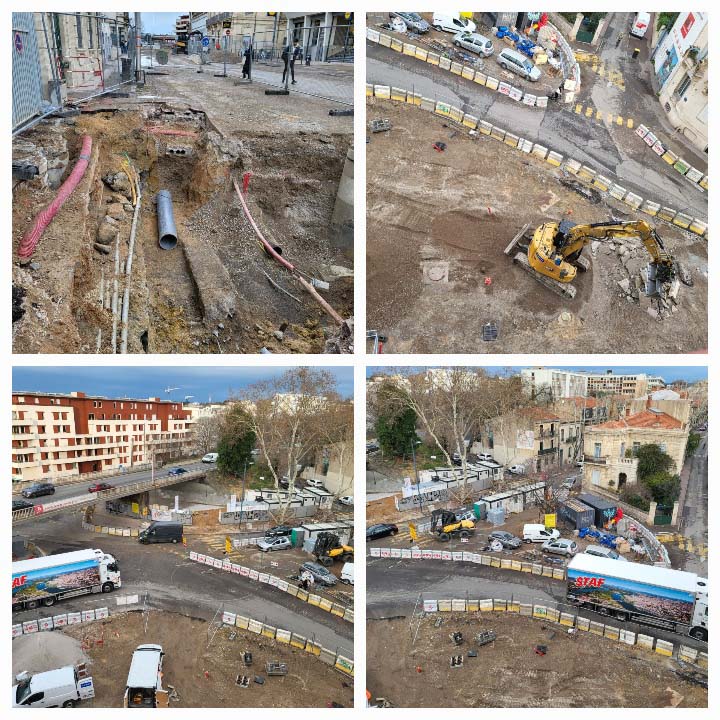
Clockwise from top: 1. repositioning & aligning underground infrastructure 2. 55 bis Ave. Georges Clemenceau from our eyrie 3. from our eyrie: traffic entering 4. and leaving – note absence of interference.
What makes Ligne 5 so fascinating to my U.S. experience filtered eyes is the way the work progresses on multiple levels without the overlay of police presence (non-existent here) people and signage directing traffic and arbitrarily regulating its flow.
There is a certain, if you will, grace about how all this activity, construction and everything else around it, flows in a kind of pas de deux. If only I were Gershwin to write a score for this ballet! As we flâneur about Montpellier I, in a Walter Mitty-esque way (fortunately, for my continued freedom) become Gene Kelly in An American in Paris, even though I’m here in Montpellier, not Paris, here where the taxis never honk their horns.
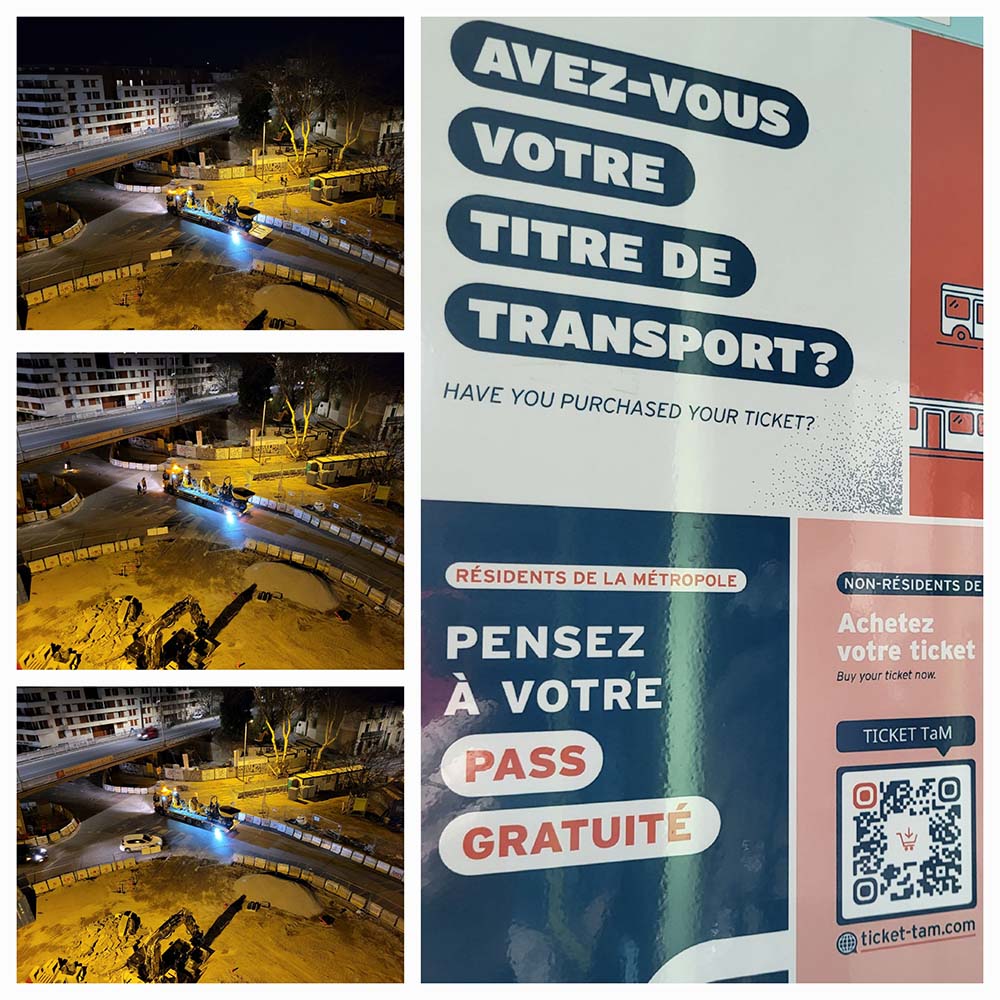
On the right: between the acts the stage hands set the stage for the next one. Taken at midnight from our eyrie. My age might provide the obvious answer to why I was up at that hour.
On the left: this, posted in every tram car and bus in the TaM system, illustrates that, while Montpellier’s residents may ride without purchasing a fare, everyone else cannot, and must use this QR code to purchase one. QR codes have become ubiquitous as artificial intelligence becomes part of our everyday lives.
I do not believe I am being paranoid in imagining that there is an A.I. version of Javert (see Les Misérables) sifting through images captured on ubiquitous hidden surveillance cameras and comparing them with France’s database of images of everyone legally in France, citizen and visitor alike, along with their legal place of residence, and identifying those who should, but do not, purchase a fare. These will eventually receive some sort of notice for “a conversation” and possibly a “re-education in civic values” if their failures exceed a certain threshold.
By way of an analogy, virtually all drivers fail to obey the posted speed limits for some reason occasionally, knowing that, below a certain threshold, they will not be “brought to justice”. But some seem to do so habitually. License plates only identify the owner of a vehicle, not the driver. But – if a camera could identify the driver – a similar A.I. “Javert” could, so to speak, separate the chaff from the wheat, and identify those drivers who need “re-education”.
Montpellier seems to have an unusually large number of driving schools. In France, offenders are required to attend and pass driver re-education classes – at their own expense – as a condition for keeping their license – or even in some cases – their vehicle, if they are the owner. Nous verrons (We shall see.
À bientôt
—
John

 La Vie de Montpellier
Leave a comment