– Aux Armes ! Citoyens ! …
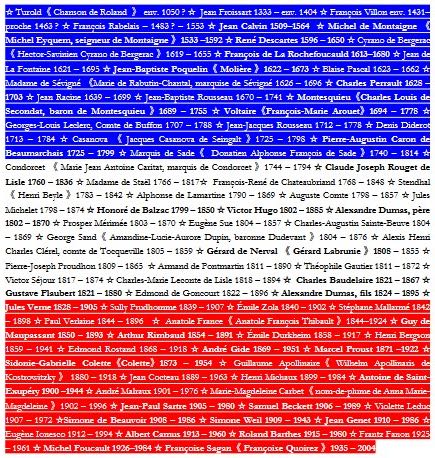
Mon panthéon des auteurs des très belles-lettres de France
This is my panthéon of my French literary “heroes” and “heroines”, the authors whom I consider to be the best in the history of French literature. It is personal and quite arbitrary. I have selected them from a very long list beginning with Turold, the author of Le Chanson de Roland (considered the beginning of French literature written around 1066 and celebrating the victory of the French army at the Battle of Roncevaux Pass in 778 CE over the Moors, although there remains some doubt that Turold was actually its author) and ends with Françoise (Quoirez) Sagan, the author of Bonjour Tristesse (Hello Sadness) only because she was born the same year as me, and I can recall reading it in the English translation while in college – for fun. The authors in boldface are the ones I’ve actually read, at least in part, and for some, their entire oeuvre. The others, while I have not read them (yet) are ones that have had an effect on French, and in some cases world, culture and literature. I gleaned these “heroes” and “heroines” of mine from a very much longer list, and acknowledge there are many who have come since Françoise (Quoirez)Sagan, but in order to create the Tricolore graphic (above) I wanted, I applied these criteria.
My dad, Eugene, was a typographer, a printer, by trade, I have ink in my veins, and have inherited his DNA in my genes. Dad was an avid, prolific reader, raconteur, and dabbler in poetry (but he inflicted the latter only on his children) and also came to France. Unlike mine, his visit was somewhat less voluntary. He came in 1918 with the 81st “Wildcat” Division of the AEF as part of the 316th Field Artillery Battalion, but fortunately, never saw combat, and lived to come home and, eventually, father me. His stories (often long and highly detailed) about his experiences “over there” fascinated me: to this day I often recall them, and like my dad, I could bore you to death re-telling them to you.
But I won’t. College was where I fell in love with typography and graphic design, and although I didn’t pursue it as a career (another long story I won’t bore you with) I dabble. One of my (as yet unread) “heroes” and “heroines”, Alphonse (Marie Louis) de Lamartine, argued for its adoption as the official flag of France, although that isn’t why I chose him. A name I inserted, (It was not on that long list) Claude Joseph Rouget de Lisle, wrote the poem that became the lyrics for La Marseillaise that in music symbolizes what la Tricolore stands for. Some of my “heroes” and “heroines” are virtually household names, familiar to anyone who reads, and others may be more obscure to many.
Some may wish to point out I have left off, or forgotten to include, someone who ought to be there. If that is the case, please enlighten me because I (obviously) enjoy learning and discussing topics like this. Some may object or question why I chose one or more that I have elevated to this high honor; and some may just be curious about something that (for the sake of brevity) I didn’t make clear. The same offer as above applies to all for the same reasons. Others may just wish to peruse my list only to explore these “heroes’ and ‘heroines” of mine. If you are in that latter group, I can assure you of hours of interesting reading. I hope you will.
Since completing the graphic above I have “discovered” three more authors that I want in my Pantheon, but decided that, instead of redoing my graphic, I would just attach attach a PDF of the list on which my Pantheon is based, now including these additions , so anyone who might wish to explore it can just download it.
The three additions are: No. 5, Clément Marot 1496 – 1544, poet, born in Cahors. I have added him because he is in the title of a book I’m about to read: Le Ton beau de Marot by Douglas R. Hofstadter, author of Gödel-Escher-Bach, which I have just finished. I added No. 26, Olympe de Gouges (born Mary Gouze) 1748 – 1793, Born in Montauban, playwright and author of the Declaration of the Rights of Woman and of the Female Citizen because France has just enshrined her philosophy into its Constitution by establishing a woman’s sovereignty over her own body. (Factoid: Cahors and Montauban are both in the Occitanie region of France, where Montpellier is.) And finally, I added No. 82, Gilles Deleuze 1925 – 1995, whose Proust and Signs I have actually read. It explores how Proust used signs, which are our first and only universal language, signs, all kinds of signs including body language, are the source of all the languages we speak, which are really meta-languages. And this is what Gödel-Escher-Bach is all about, and in a recursive way, gets back to my first addition, Clément Marot. Hofstadter is an American, like me, and a fellow francophile.
II – J’ai adoré Bordeaux, mais mon cœur est à Montpellier
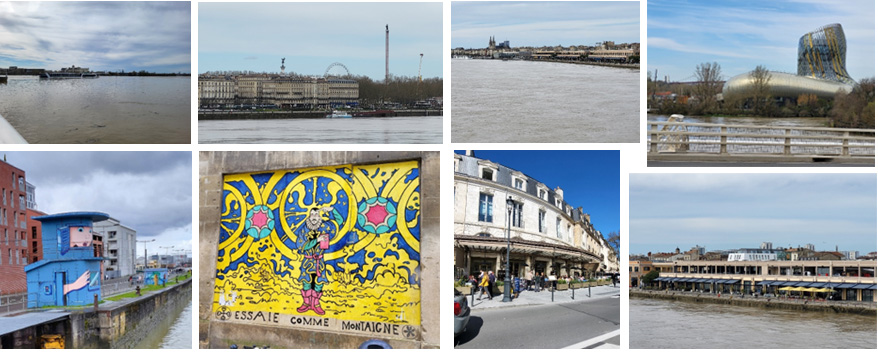
Three weeks to the day after we had to detour, on 12 March we left Montpellier before dawn for Bordeaux. France’s rail system, Société Nationale des Chemins de Fer Français better known by its acronym, SNCF, connects to all the major cites in France, but not all connections are the high speed TGV (Train à grande Vitesse) most of the intercity trains operate at much lower speeds, and we made several (six) stops before reaching Bordeaux at the end of a four-and-a-half-hour journey covering around 235 miles. The TGV covers the 369 miles to Paris in just a little over three hours and two stops. Still, riding on a train has its charms. There are no security issues to deal with, the seats are comfortable, the ride is smooth, and the French countryside is pleasant to look at. We arrived a little after 1:00 p.m. and having purchased passes for Bordeaux’s tram system in advance online, we were able to get to our hotel with a minimum of trouble, and the tram ride gave us a little preview of the city.
The Garonne River defines Bordeaux as much as the city defines the wines that are made in the river’s valley. Before Julius Ceasar’s legions arrived in Gaul before the Common Era there was a small fishing village on the right bank of the Garone that became Bordeaux. The Romans introduced grapes, and wine making. The soil on both sides of the Garonne proved to be excellent for producing excellent wines, and the peninsula between the river and the Atlantic Ocean made Bordeaux an excellent port from which the wines could be shipped to other places, especially England. The region was known as Aquitaine, and the wine trade made it wealthy. It made one of its nobility, Eleanor, born around 1122, so wealthy that she could annul her marriage to one king, Louis VII of France, and marry another, Henry II of England. She was not just another pretty face. In addition to bearing eight children by Henry, she was a political force, even conspiring with one of her sons to usurp her husband. When the plot failed she was imprisoned by Henry for almost sixteen years before returning to Aquitaine with two of her sons. Aquitaine continued to be a part of England until the end of the 100 Year War in 1453 when it became part of France. There is still a strong connection between England and Bordeaux, and anglophones like me feel very much at home.
Expect the unexpected in Bordeaux – I will try like Montaigne to understand why and what, why not?
But I will spare you my regurgitating the history of Bordeaux as much as I am tempted to tell you all about Montaigne, Montesquieu (the former a two-time mayor of Bordeaux) and Napoleon . Instead I will urge you to consider paying a visit there. We were there just the better part of three days, and except for arriving and departing, never left the city limits. The 72 hour tram pass was perfect. It allowed us to get on and off trams and buses with literally just a wave of our cell phones at the app reader. You can even take a tram (Ligne B) to Chateau Pape Clement and Chateau Haut-Bacalan in appellation Pessac-Leognan.
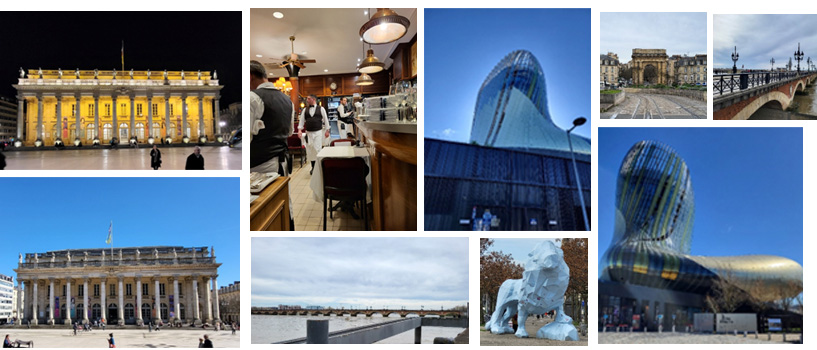
From our hotel it was a short walk to La Cite du Vin (above) part museum, part wine shop extrordinaire. Its unique architecture suggests a carafe and from the restaurant near the top there are tremendous views, but we didn’t go there: there was so much else to see. We did take a tour of Bordeaux by France Voguette, these are small trains pulled by an electric powered engine made to look like an old-fashioned steam locomotive pulling four open cars with about four rows of seats equipped with head sets that narrate the tour in six different languages. (most cities in France of any size, except Paris, have one of these trains.)
From sidewalks to along the Garonne, restaurants are everywhere. On the right, Brasserie Le Noailles
Food is virtually synonymous with wine, and Bordeaux has an embarrassing number from which to choose. From Michelin starred to (my favorite) brasseries, and every conceivable cuisine from everywhere. We chose the dark green awninged Brasserie Le Noailles (founded in 1932) on Allees de Tourny (no alley, it is a major esplanade leading to the opera house on Place de la Bourse).
Day or night, Le Grand-Théâtre de Bordeaux, completed in 1780 by Architect Victor Louis, dominates Place de la Bourse
It proved to be the perfect way to end our only full day of touring Bordeaux. Our waiter, Frank (not Francois!) was a gem. The food was marvelous. We chose a Crémant de Bordeaux, a sparkling wine made in the region, as the perfect accompaniment for all three courses. Afterwards there was just a touch of spring in the air that made our walk to the tram, and from the tram to our hotel very pleasant.
This rather modern lion guards the eastern approach to the seventeen arched Pont de Pierre while Napoleon’s grand arch is at its western end. Today trams, trucks, and automobiles share the route his Grand Armée marched across.
Until 1960 the only bridge across the Garonne was the Pont de Pierre, built by Napoleon I to get his troops onto the peninsula between the Garonne and the Atlantic Ocean. Its seventeen arches still carry major traffic plus the tram Ligne A and link both sides of the city. Much of the peninsula is now natural park along with beaches on the Bay of Biscay.
To sum it up, Bordeaux is definitely a destination you should consider if you visit France, and not just for the wines of the region. If you like city life, the vibrancy, the culture, the history, you will love Bordeaux.
Writer/Editor Comment
Many of you have in the past been so kind as to reply to my scribblings, and I’ve responded to some of you with my thanks, and sometimes with additional comments of my own. As I said at the outset of my sending out these occasional reports on our lives here, you always have the option to do so, or if you wish, to delete of block them. Recently I have been musing about turning these email reports into a blog on some platform like WordPress or Substack, but to be quite frank, I am ambivalent about doing so, as I have no direct experience with doing so. I did attempt it once long ago, but found the process so daunting for me (or I was just too lazy) that I abandoned the project. So, if you wish to share your thoughts, pro or con, about blogging I would find that useful and appreciate it very much.
À bientôt
 La Vie de Montpellier
Leave a comment