May Was a Marvellous Month
And a merry one too! With warmer (but not too warm) days, longer hours of daylight, and more sun we
began to really enjoy spring.
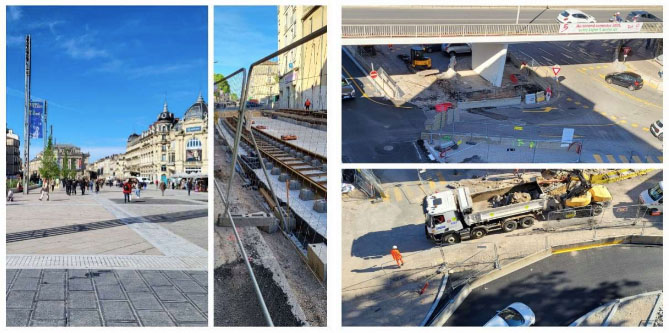
Clear blue skies over Place de la Comedié (below) made it delightful, while the Ligne 5 tram’s rails are starting to go in place (above) and we have seen a lot of Ligne 5 progress right at
our doorstep. Just this week some of the area received the first new pavement opened for traffic. It was
intriguing to watch how quickly drivers here adjusted to the new traffic pattern – an intersection with
vehicles coming from six different directions and no STOP or Yield signs, nothing but arrows painted on the
pavement to guide them through and no police presence at all.
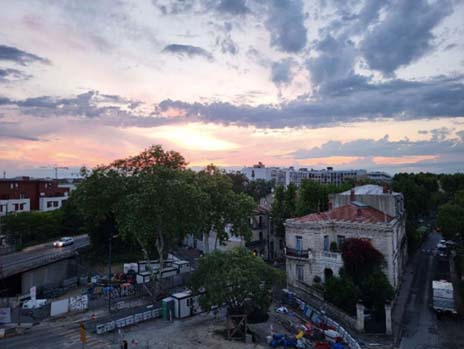
Sunsets are now after 8 p.m. and have shifted north, and our neighbor’s Bougainvillea is now in full bloom.
May 13th – The Olympic Torch Arrives on Its Way to Paris
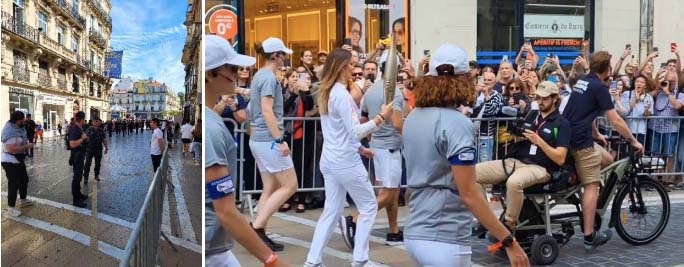
This event made it virtually a holiday in Montpellier (France has four “official holidays” in May: the 1st
Labor Day, the 8th – commemorating VE day, 18 May 1945, the 9th – Ascension Day, and the 20th – Pentecost
Monday.) certain streets along the route were closed and traffic re-routed, tram and bus services
suspended, and more than the usual Monday shops and cafes were closed along it. Some streets along the
route were lined with barricades and gendarmes (Police Nationale) and the torch bearers were
accompanied by an entourage of other athletes, officials, and police escort on motorcycles. There were
special events along the route of music and athletic demonstrations. It also coincided with an international
extreme sports competition along the banks of the Lez.
May 8th – A Visit to Lattes (and 40 Thousand Years Ago)
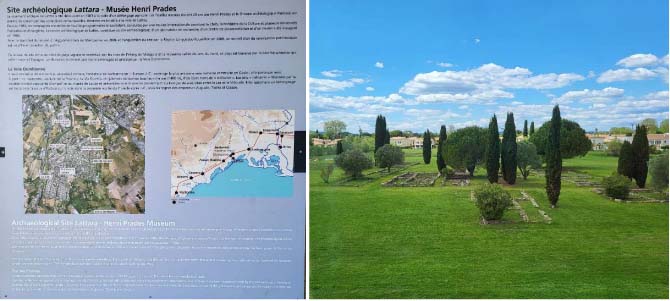
Lattes is a commune (city) a little over 4 miles from our home in Montpellier by foot, but only 45 or so
minutes by tram including a 10-minute walk and a connection from ligne 2 to ligne 3 at Gare Saint-Roch. As a community it has been continuously inhabited for some 40 millennia; first as a pre-historic fishing village
on the coast, and from that beginning as an Etruscan outpost to a Roman colonial center (Lattara) to a
Medieval fief (to a one-time Nazi radar installation!) until today, a suburb of Montpellier connected to it by
tram. Between its city limits, and to the south is the Etang du Mejean, a lagoon (bay) separated from the
Mediterranean by a narrow strip of beaches extending from the Camargue to the east to Sete on the west.
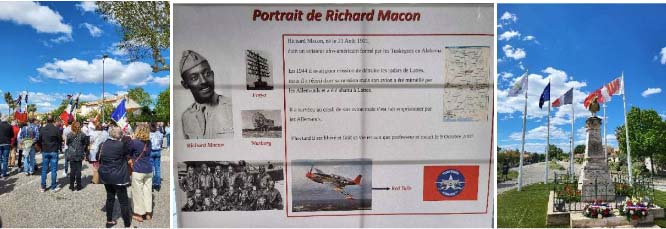
8 May 1945 was the day the Third Reich surrendered to the Allied forces in Europe and is commemorated
in France in much the same way as Memorial Day is in the United States. We arrived in Lattes in time to
witness this ceremony. In visiting the reception afterward we saw this tribute to the Tuskegee Airman who took out the Nazi radar station as part of Operation Torch that paved the way for the invasion of Italy: an
interesting piece of history. On the right is Lattes’ monument commemorating an event we must never
forget.
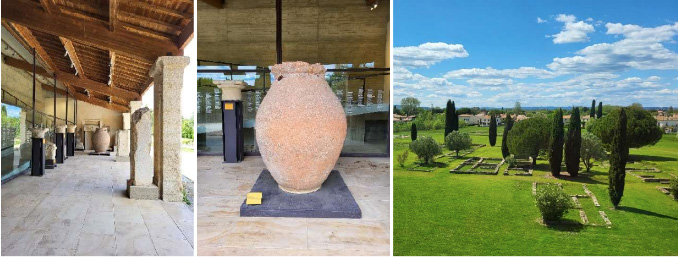
But we had come to Lattes to visit its Musee Henri-Prades. Long before the Etruscans came to its shores
there were people here engaged in agriculture and fishing. Surrounding Lattes in every direction there are
buried remnants of human occupation. Henri Prades was a teacher and self-taught archaeologist who
brought history – and pre-history – to life here in Lattes. Born in 1920, he was a fighter in the Resistance.
May 11th – Maguelone
Another ancient site near Montpellier, reachable by the ligne 4 tram to Garcia Lorca, taking the 32 bus to
the Pilou stop in Villeneuve-les-Maguelone and walking about 2 miles and crossing the Canal du Rhone a Sete on a pontoon bridge (there’s a car park because from that point on it’s a la pied) to the former
Cathedrale de Maguelone (the see was moved to Montpellier in 1536 by Pope Paul III at the request of
Francis I as the Barbary pirates found Maguelone easy picking and malaria was epidemic) which remains a
parish church and is also a vineyard and winery.
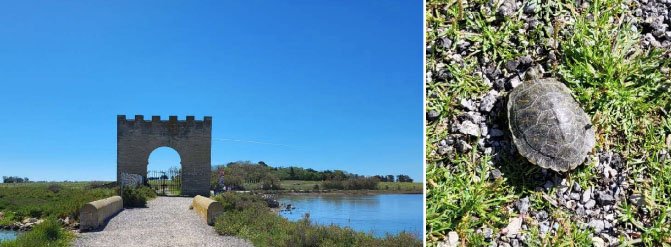
It’s a pleasant walk. On the way to the causeway leading to the bridge we encountered this fellow traveler.
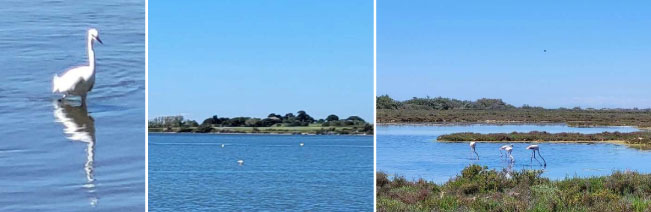
Shorebirds of all kinds are everywhere and the etangs are filled with flocks of flamingos.
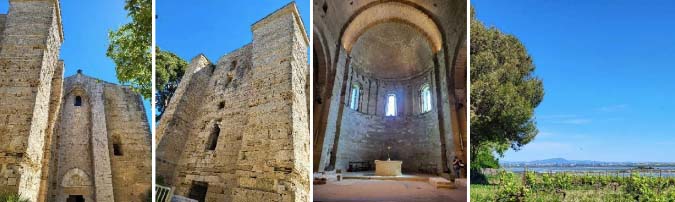
The construction of the Cathedrale de Maguelone began around 1160 and was completed around 100
years later. Because of its location it incorporates some of the features of a fortress. It was designated as a
French national historic site in 1840 and is one of the few remaining examples of Romanesque architecture.
Today it is surrounded by vineyards. In the distance is Pic Saint-Loup, about 12 miles north of Montpellier.
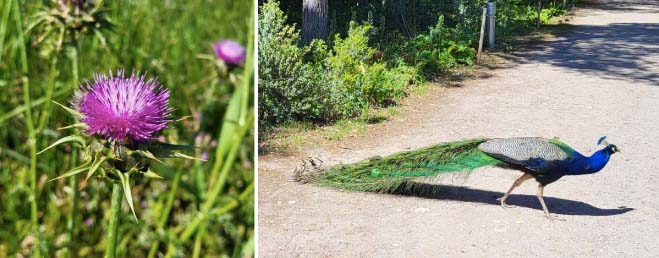
Wildflowers, like this thistle above, are in bloom everywhere; but certainly not peacocks!
May 20th-22nd – Narbonne
It may sound strange to some (but maybe not to more than a few) that we would devote almost three full
days to going to lunch. But Les Grands Buffets in Narbonne is hardly just “going to lunch”. This “all-you-can-
eat” restaurant is one of the most coveted reservations in tout France and beyond. Very often it takes
making one months ahead (as much as a year) but we were looking for “someplace special” to celebrate
the 27th anniversary of the day we met in Boston – 18 May 1997 at the corner of Charles and Boyleston –
and Bonny found an availability on the 21st for lunch at one o’clock. After making the reservation and
purchasing our train tickets we heard a rumor that the CGT was threatening to strike that day. Having been
caught before by that, we took no chances and decided to leave the afternoon before and were able to change our tickets and add a night to our hotel reservation at Hotel Galla Placidia in Narbonne.
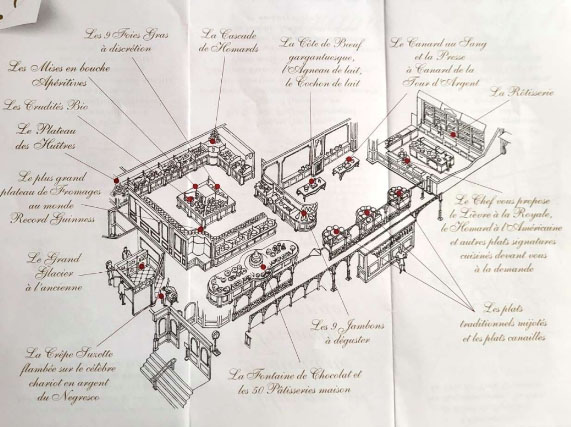
Les Grands Buffets is located on the western edge of Narbonne in a large sports complex, and reachable by
a free shuttle bus with a stop just outside Hotel Galla Placidia. In addition to Les Grands Buffets the complex has a skating rink and a bowling alley with a wonderfully cozy bar (called “Private Bar” where we
waited, sipping coupes of Moet et Chandon until the time of our reservation). The restaurant is quite large,
easily seating several hundred patrons at a time, formal looking with white tablecloths and napkins and waiters in tuxedos, and at the same time very welcoming. The website says dress for an “occasion” and while that’s not a problem for us it was obvious there were no “dress police” enforcing it, but that’s okay. From the chart above you can see that there was virtually no food group not provided. Being wise and guided by common sense (an awareness of the punishment that comes from over consumption) we had anything we wanted in whatever quantity we desired. When one plate was empty, we could go on to the next, and the next, etc. In spite of every good intension, it was still way too much of a good thing. We decided to not bother with looking for some place for dinner. The quality of the food and its preparation is very good: even if not like a Michelin starred restaurant, everything is the highest quality. The wine list is exhaustive – for a price of course, you can have everything you would care to imagine. Some of the classic examples of French cuisine on offer do suffer from the necessity of being prepared well ahead of serving, but the cheeses on offer is mind boggling. And… there’s only so much fois gras and caviar one should eat at one meal – or can.
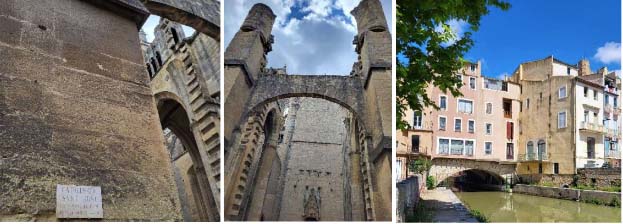
Narbonne is a wonderful city, worth visiting even if Les Grands Buffets is not your cup of tea. It is considerably smaller than Montpellier, but even older, and with wider sidewalks and fewer hills. The Canal de la Robine winds through the old part of the city, and the Cathedrale Saint-Just et Saint Pasteur, begun in
the 13th century but never completed, is a uniquely beautiful example of Gothic architecture. (More on that
below.) It was the first colony founded by the Romans in Gaul. The Pont des Marchands across the Canal de
la Robine is reminiscent of the Ponte Vecchio in Firenze. The covered market (below) was a visual feast
every bit as tempting as Les Grands Buffets.
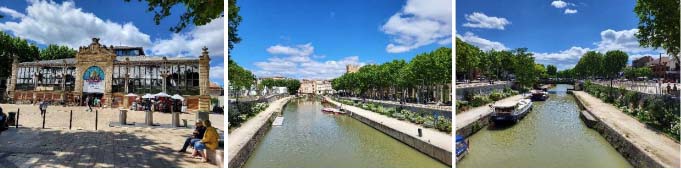
The canal side is lined with boats for hire, by the hour, or by the day. We decided to only watch them move
through the locks at a guinguette beside the canal before returning that afternoon to Montpellier.
Cathedrale Saint-Just et Saint Pasteur is sufficient reason to visit Narbonne; and not just for its Gothic
Architecture. I find it difficult to describe that exactly, so I am hoping these pictures will give you some idea.

This garden at the Cathedrale entrance – inside this parterre of red and white roses within a cloister.

These pictures show just the nave, illuminated by windows high above and over the yles, which are wide
enough for chapels on both sides. The carvings embellishing the organ are too intricate to fully describe, but they depict musical instruments as well as allegorical heads, and it is surmounted by gilt angels
celebrating the assumption of Mary at the center. The high altar is separated from the apse by a curtained
screen, and over it is a baldachin with two archangels atop the front columns and putti on the rear.
Yes May was marvelous, magnificent even. Beside all the traveling, we.ve found several new restaurants to
enjoy, and we managed to move ahead significantly on establishing our French residency. All the hurdles required for our Cartes Vitales have been cleared; Bonny has hers, and mine will arrive in a week or so. We finally have our appointments next month (June) for the health examinations required for residency in
France, and the weather has brought days that make one begin to think about heading to the beach!
À bientôt
John
 La Vie de Montpellier
Leave a comment