June “Busted” Out All Over (Apologies to Rogers and Hammerstein)
June (on the 12th) marked the beginning of a new year for me, and all I will say about that is “keep ‘em coming!” There is nothing that we enjoy more than playing tour guides for those who come to visit us here, and this was our first crack at that when my daughter, Sallie, and her husband, Kevin Kennedy, flew in from Paris before returning to their home in Massachusetts. I know many (maybe most) of you prefer my photos to my prattling, so since I’m now sending these scribblings as a blog I can embed as many as I want without worrying about your email server (or mine) “editing” as they now seem to do.
La Grande Motte – 4 June
Before 1962 the Mediterranean coast west of Marseille from the Camargue between the Bouchées de Rhone consisted mostly of small fishing villages like Grau-le-Roi and Palavas-les-Flots separated by low beaches that formed a string of etangs (ponds or lagoons) surrounded by marshes through which the lesser known extension of the Canal du Midi (that was built in the 17th century to connect Narbonne, and latter, Sete to Toulouse) the Canal du Rhone a Sete was a major
transportation route in the times before trains and highways. Life in Occitanie up to then was not much different than it was when these canals were built. “La Grande Motte” in French literally means “The Big Lump”; and there was a slight rise of land here.
But President Charles de Gaulle and his ministers foresaw an opportunity here to bring tourism to the region and commissioned Pierre Racine to plan it. He, in turn, commissioned architect Jean Balladur to design the La Grande Motte – only one of just four cities (the capital of Bangladesh, Chandigarh, Le Corbusier, the capital of Brazil, Brazillia, Lucio Costa, Oscar Niemeyer, and Joaquim Cardozo, and the capital of Australia, Canberra, Marion Mahony Griffin) are the
only existing cities in the world totally conceived and created by a single architect or architectural group.
Between 1963 and 1983 Jean Balladur’s vision rose with every structure reflecting his inspiration of pre Columbian Central American architecture. Today sun seekers from all over Europe come to bask in the sun, enjoy the surf, and dine in its restaurants. To reach it we take the Ligne 1 tram to Place de France and catch the 606 Oli bus that drops us within just a few minutes stroll to the sand.
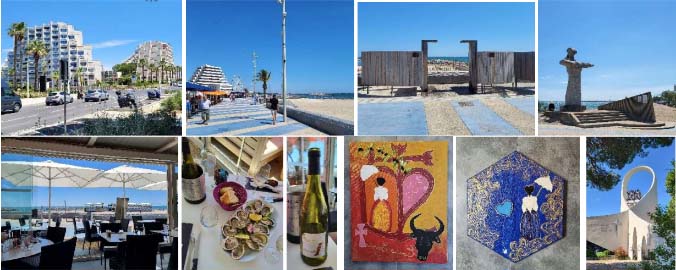
And after the sun and sand, a little nourishment for body and soul. I’m sure even Saint Augustine would approve.
Camargue – 11 June
My daughter, Sallie, and her husband, Kevin Kennedy, arrived from Paris the day before, eager (even willing!) to go on a safari in the Camargue, even having to catch the 606 Oli bus at 6:00 a.m. this day. It was the only time that would get us to Grau du Roi in time for the Land Rover’s departure at 9:30. Place de Comedié was (almost) deserted at that hour, and the Ligne 1 tram’s arrival there arrived at Place de France at 6:00 a.m. so it was a nip and tuck connection! But we made it, and after a leisurely petit dejeuner in Grau du Roi, our Land Rover driver, Jonathan, picked us the four of us and
another couple with there young son; and off we went to the Camargue, passing by the Louis IX fortress at Aigues Mortes.
The Rhone divides at Arles into the Bouches du Rhone, the main east branch entering the Mediterranean at
Embouchure-du-Rhone, a few kilometers west of Marseille, and the more meandering west branch that winds its way there at Saintes-Maries-de-la-Mer. This roughly approximate triangle is the Camargue, 360 square miles, and the largest river delta in Western Europe. Most of the Camargue is a National Park, but much of it is held by families whose history goes back hundreds of years. Its salt and rice are highly prized and it is a major fly-way for bird migration. Flamingoes, ducks, and swans live there permanently. There are also herds of horses and bulls that live in free range, not exactly in the wild, but we were strongly cautioned to not attempt to approach them. The Camargue horses are a dull brownish grey until they are between three and four years old, when their coats turn white. They are marked with the brand of their nominal owners, and there is an annual round-up of them. The bulls (and the cows) are black – with horns – and they are highly prized for bullfighting. Bull fighting continues in a number of cities in southern France: Nimes, Arles, and some others have regular bullfights, called “course camarguaise”, but the bulls are not killed. Still, it is a sport I don’t think I would want to see. But, rather than rambling on…
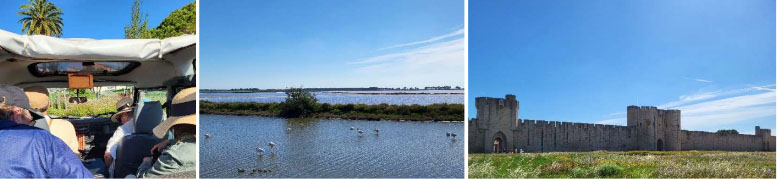
Bonny riding shotgun. Flamingos and ducks everywhere as we head into the Camargue. Louis IX’s Agues Mortes fortress.
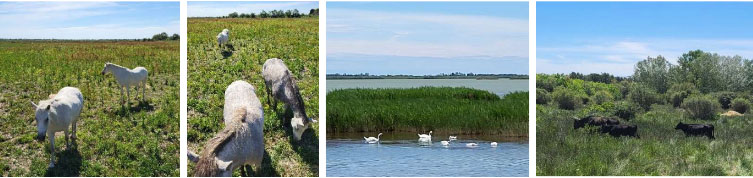
The coats of the horses turns white in about 4 years. Seven swans a-swimming. This family is part of a much larger herd.

C’est moi. Kevin & Sallie at Mas du Notaire. Jonathan, our driver extraordinaire. Sallie, Kevin, and Bonny taking in le vin. The safari was so much more than riding over the Camargue. We stopped at this winery for a little refreshment and a perusal of the products it had for sale. We left with some wine (bien sur) some Camargue fleur de sel, and olive oil made from Picholine olives. This is the Costières de Nimes AOC (Appelation d’origine controle) the southernmost Rhone wine region. They produce red, rose, and white wine blends plus a sweet muscat. “Mas” is Provencal/Occitanie for “place” or “farm” and “Notaire” means “Solicitor” (a lawyer) in French who specializes in legal matters, as opposed to one who
tries cases in a courtroom called an “Avocat”.
Four Score and Nine – 12 June
Quatre-vingt-neuf in French, mon anniversaire, and we, Bonny, Sallie, Kevin, and I, celebrated in high style! We have, as you may imagine, a lot of favorite places here, but being my birthday, I got to chose and chose Hotel Pinard, a wine bar in the heart of Montpellier run by two of our friends here, Benjamin and Szabi, who opened about a year ago. Because there would be the four of us, we requested the “back room” with the walls lined with maps of the wine regions France. Beginning with Champagne (bien sur!)
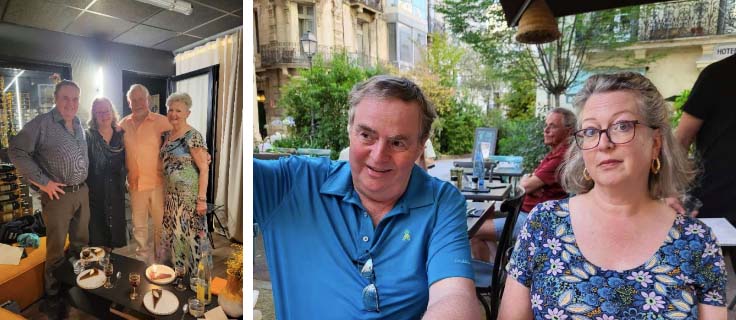
And just because this picture on the left is a bit dark, here’s Kevin and Sallie at La Coquille when they arrived on Monday.
Jardin des Plantes – 13 June
Last winter I wrote about our first visit to Montpellier’s Jardin des Plantes, but at the risk of repetition, it is France’s oldest botanical garden, established by royal charter from Henri IV in 1593 by Pierre Richer de Belleval as part of Montpellier’s University’s School of Medicine. One of that school’s students was Francois Rabelais, who was expelled for concocting drugs using ingredients he purloined from le Jardin. Seems he was ahead of his time. He is commemorated with a sculpture (below) in le Jardin. Rabelais is not the only fauna in Le Jardin des Plantes…
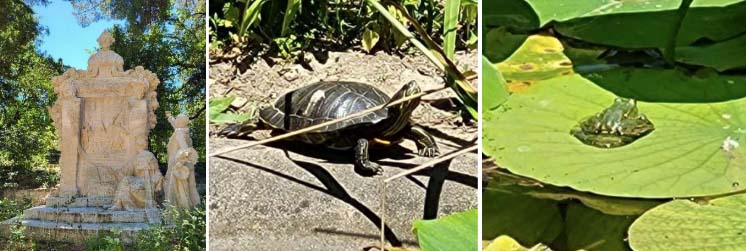
But you come here for the plants and the flowers, so…
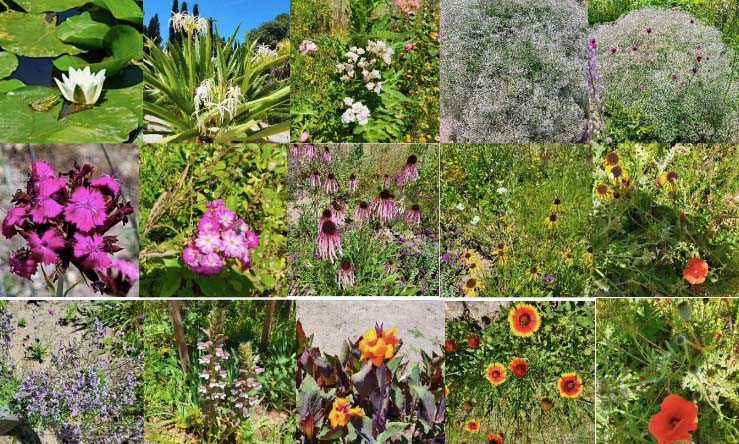
It just might have been the buds of that flower in the lower right corner that got Rabelais thrown out.
Place de Comedié et Esplanade Charles de Gaulle – 21 June
The half mile from the Opera House in Place de Comedié to Le Corum at the northeast end of Esplanade is Montpellier’s six acre “living room” and crossroads where tout le monde comes to shop, to play, to eat, to seen (some even work here!) and is never really deserted no matter the hour of day or night. For over a year now this area has been undergoing extensive renovations that included a total replacement of the Esplanades old rather ordinary fountain with
something more like a water park for everyone. To celebrate this metamorphosis the Mayor called for a celebration on 21 June to commemorate its opening – and to celebrate the summer solstice and the “official” beginning of summer.
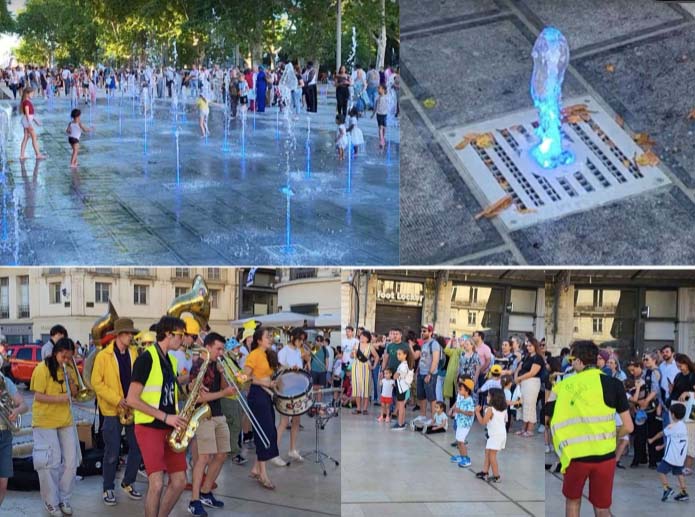
Along with the new “water park” there was a band playing at the base of Place de Comedies’ Fountain of the Three Graces accompanied by some very talented and rather young dancers really grooving to the beat…
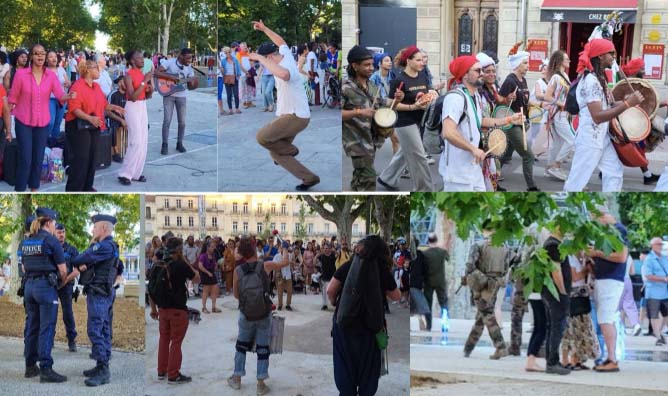
and gospel singing, break dancing, a parade, very visible security, drumming, and some less obvious security, it was a joyous time for all who turned out.

The feature attraction of the event was jazz pianist Laurent Coulondre with Remi Bouyssiere on bass and Martin Wangermeee on drums (the trio Schizophrenia) who performed an unforgettable set on a stage set up at the middle of the Esplanade concourse. In 2020 Coulondre was named French Musician of the Year by Jazz Magazine. His recordings are available online in Mp3 format only.
Bienvenue à l’été – 22-30 June
This last week of June was not only “officially” summer, but it also felt like it. Except for today, Saturday, temperatures reached the 80s every day and the evenings were noticeably warmer too. And it was quite eventful too. I now have my Carte Vitale which gives me access to the French healthcare system. That plus our supplemental health insurance (both of us) are covered for almost 100% of our healthcare needs. Monday was our usual laundry day when we put our stuff into wash then repair to the Café Paume for an apero (Chardonnay for Bonny, Ricard for me) while it spins. We also have submitted our applications for renewal of our visas and for our Cartes de Sejour, another card to carry showing that we are indeed residents. Before we tackled that task on line with the help of our Renestance guide on Tuesday we treated
ourselves to a grand petit dejeuner at Café des Arts. On Wednesday we were off to Palavas-les-Flots for a dip in the Mediterranean and catching a few rays on the beach.

Café Paume, Café des Arts, Palavas-les-Flots, Everywhere you go in Montpellier you will find flowers growing.
Friday afternoon we received word that we have had an offer for our house in Millsboro Delaware! We made a counter-offer then accepted the counter-counter offer, so if all goes well (fingers crossed) we just might have a contract of sale very soon.
À bientôt
John
 La Vie de Montpellier
Leave a comment