5 Fevrier – Pavillon Populaire – Gisèle Freund Expo
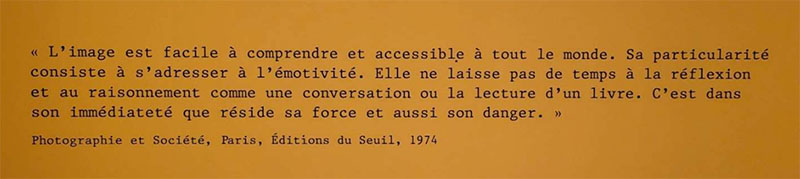
“The image is easy to understand and accessible to everyone. Its particularity consists of addressing emotionality. It leaves no time for reflection and
reasoning like a conversation or reading a book. It is in its immediacy that its strength and also its danger reside.”
– Photography and Society, Paris, Éditions du Seuil, 1974, [The French text above photographed at the expo.]
Gisèle Freund was born in Berlin in 1909 into a wealthy family who envisioned a life for her of a marriage to
someone with a similar background, but she had other ideas. In 1931 she left Berlin to study sociology and art
history at the university in Freiburg and the next year moved on to the University of Frankfurt, until 1933, when that March she escaped from Germany: her left-leaning politics and Jewish heritage having made it dangerous for her to remain there. She arrived in Paris and enrolled in the Sorbonne to continue her studies. Her father had given Gisèle a Leica camera, which she used mostly for documenting her sociology research; but when Andre Malraux asked her to photograph him for an upcoming book, and later he invited her to document the First International Congress in
Defense of Culture in 1935; it led to her being asked to take this picture of James Joyce for the 8 May 1939 cover of Time magazine.
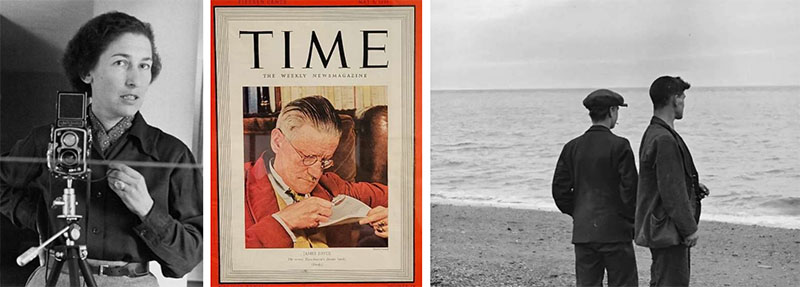
But Gisèle’s primary use of photography was for documenting the plight of those being left behind by the immense changes coming into the world. The picture on the right (above) is one in a photo essay she made on the effect deep unemployment was having on the Newcastle-upon-Tyne shipbuilders in the U.K. during the Great Depression; left with nothing to do but stare out to sea.
When WW2 began Gisèle went to South America and Mexico. She went to Terra del Fuego at the tip of South America across the Straights of Magellan, and made a documentary film on the conditions of the indigenous population and did similar work in Mexico. Denied entry to the U.S. because of her membership in the Communist Party as a student, Gisèle returned to Paris and continued her work as a photographer and writer. She published her Sorbonne doctorate thesis, Photography and Society, in 1974.
Gisèle died 31 March 2000. The Pavillon Populaire, located adjacent to the Esplanade Charles de Gaulle, is devoted to photography expos and the admission is without cost. It is supported by the city of Montpellier and its citizens.
13-15 Fevrier – Paris
As noted in the previous issue of La vie, we had made plans to go to Paris for the purpose (in part) of touring Notre-Dame de Paris. “The City of Light”, as always, richly rewarded us with her charms for our effort. (And by “effort” I mean getting up a little earlier than usual, getting dressed, finish packing, and walking across the street to Paul in Gare Sain-Roch for our petit dejeuner before boarding the TGV around 8:30. Since we can look out from our bedroom and look at Gare Saint-Roch, any “effort” on our part was minimal.)
13 Fevrier – Musée d’Orsay et Au Cochon Volant
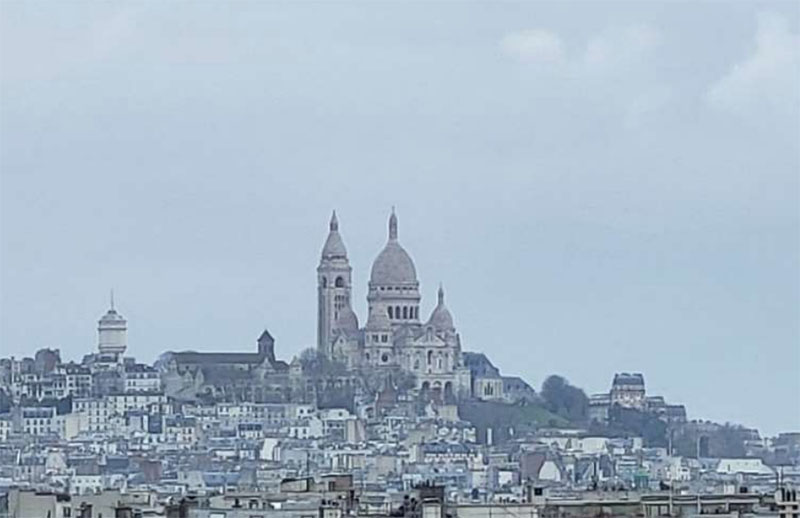
We arrived at Gare de Lyon (on time) just a little after noon, and after checking into our hotel, we walked across the Seine to Gare Austerlitz to take the RER C directly to Musée d’Orsay (across the Seine from the Jardin des Tuileries). The Musée d’Orsay was originally built during the Belle Epoque as the Gare d’Orsay (named after the Quai d’Orsay nearby on the Seine’s left bank) and was used for some of the settings for the 2011 film, Hugo. In the repurposing of the building for the Musée, the iconic gigantic clocks that were featured in that film were retained; through which you can see Basilique du Sacre Coeur de Montmartre.
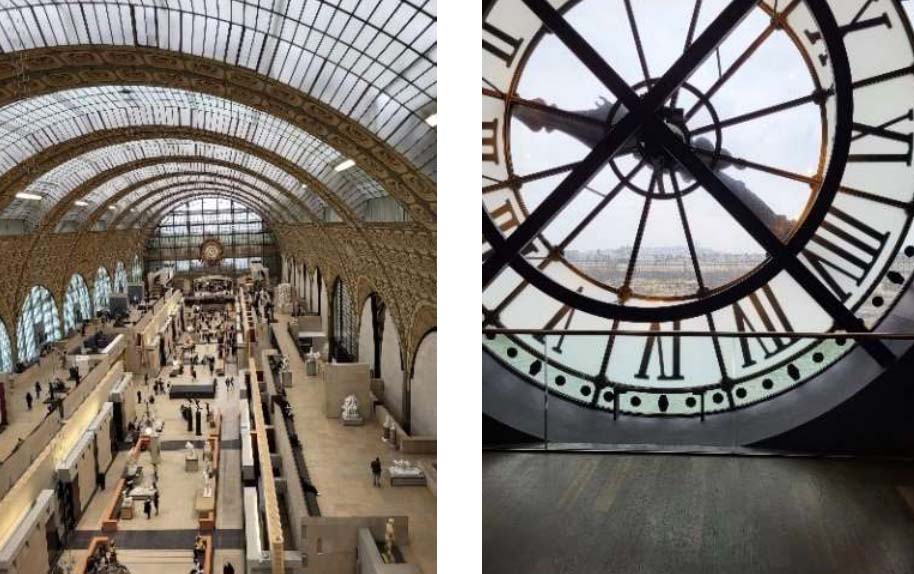
We especially wanted to see the expo there of Impressionist paintings that was going to end the following day. Musée d’Orsay is one of our favorite museums in Paris, much less crowded than the Louvre (and which has an interesting restaurant that we hope to visit some day). Both of us had recently read Jackie Wullschlager’s biography: Monet, The Restless Vision, and many of the paintings that she wrote about were on view.
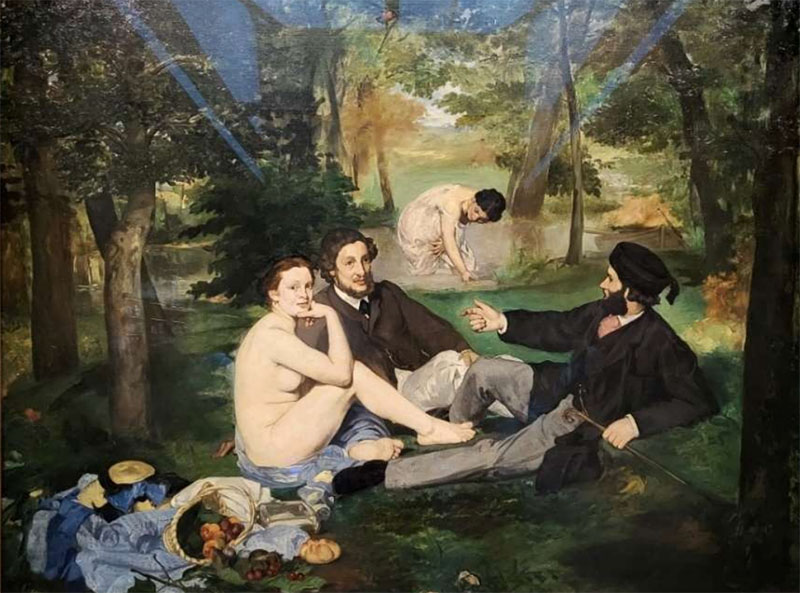

On the left is a photograph of Edouard Manet’s Le Dejeuner sur l’herbe (painted in 1862-63) and on the right a photograph of Claude Monet’s Le Dejeuner sur l’herbe (painted in 1865-66) in response to it. (Notice how the glass, protecting the paintings, is reflecting in both photographs.) But being able to see the originals, their true colors and the brush strokes, and impossible to capture with a cell phone camera, was a genuine thrill. Both paintings are in the Musée d’Orsay’s permanent collection, but are sometimes on loan to other museums.
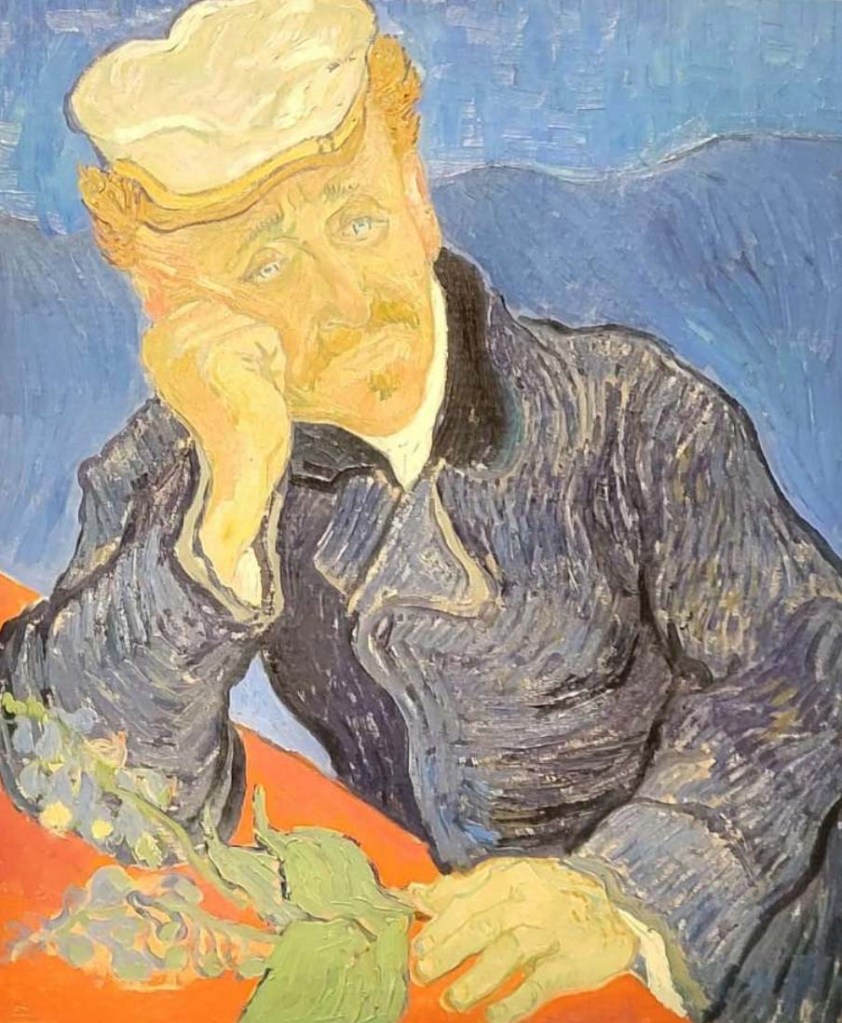
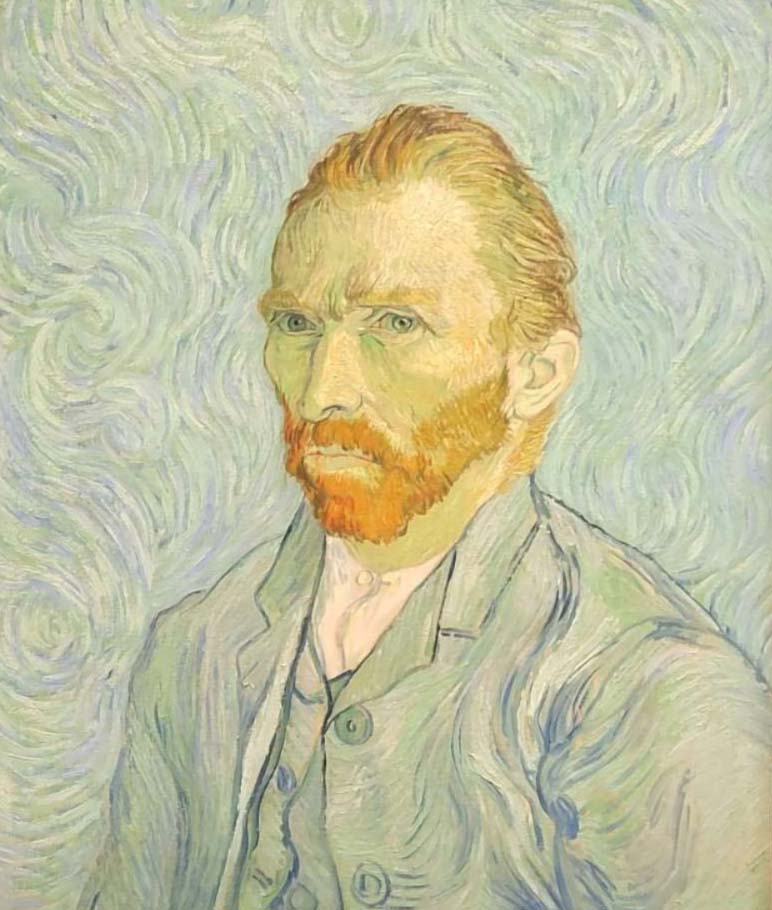
Two other paintings in Musée d’Orsay’s permanent collection that I photographed are (above) Van Gogh’s Portrait of Dr. Gachet (left) and his last self-portrait that he painted in 1889. Van Gogh’s distinctive brush strokes in these, and his other Post-impressionist paintings as well as his unique and powerful use of color make his work virtually synonymous with the artist himself.

But one cannot live on art alone – we ended our evening with two rotisseried porcelets here at Au Cochon Volant – and taking enough leftovers home (yes, you can do that now in France in most restaurants since COVID) for two more meals!
14 Fevrier – Notre Dame de Paris
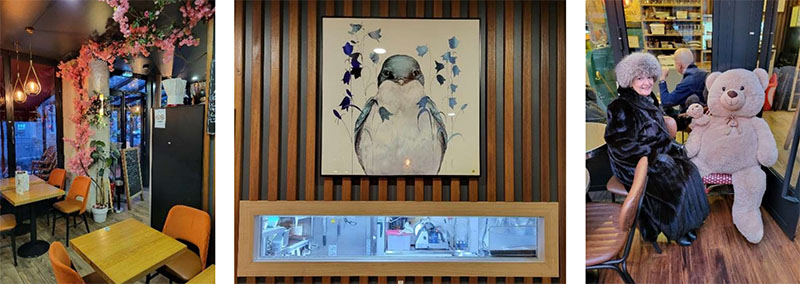
We stopped here at l’Hirondelle (The Swallow) on Boulevard Henri IV near Place de Republique for petit dejeuner to fortify ourselves for walking to Notre Dame on this very cold (freezing) morning before dawn. Very few places are open at that hour, and the food at l’Hirondelle was as warm and tasty as its décor.
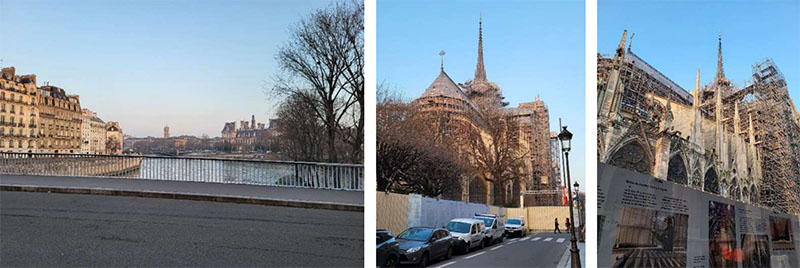
We walked down Boulevard Henri IV and crossed the Pont de Sully onto Ile Saint-Louis to Pont Saint-Louis to Ile de la Cité to approach the east end of Notre Dame where there is still extensive construction activity. The interiors and the west façade are glorious. We had a pre-recorded tour app with a keyed map on our cell phones to guide us.

After touring Notre Dame we walked along the Seine down to the Louvre, but there was no way we were going to stand on line to go in there because, despite the clear blue sky and lack of wind, the temperature was still freezing!

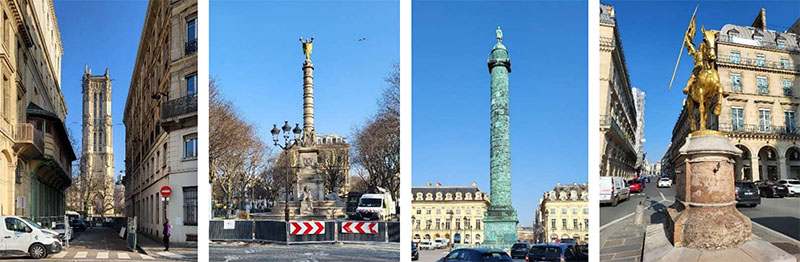
Paris has many more towers besides the Tour Eiffel. Among them (L to R) are Tour Saint-Jacques, Place du Chatelet, Place Vendôme (and golden Saint-Jeanne d’Arc at Place des Pyramides).
15 Fevrier – Des Champs Élysées
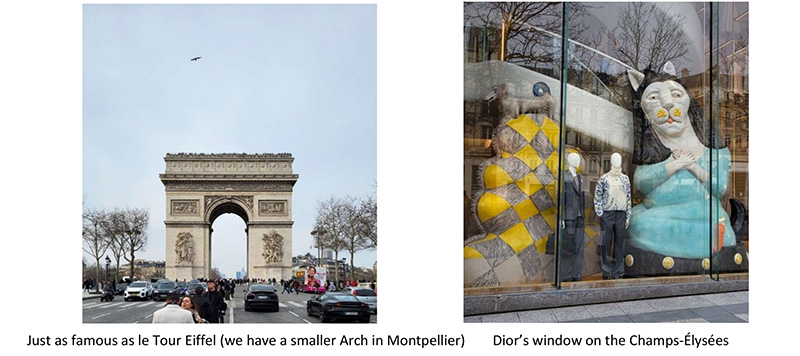
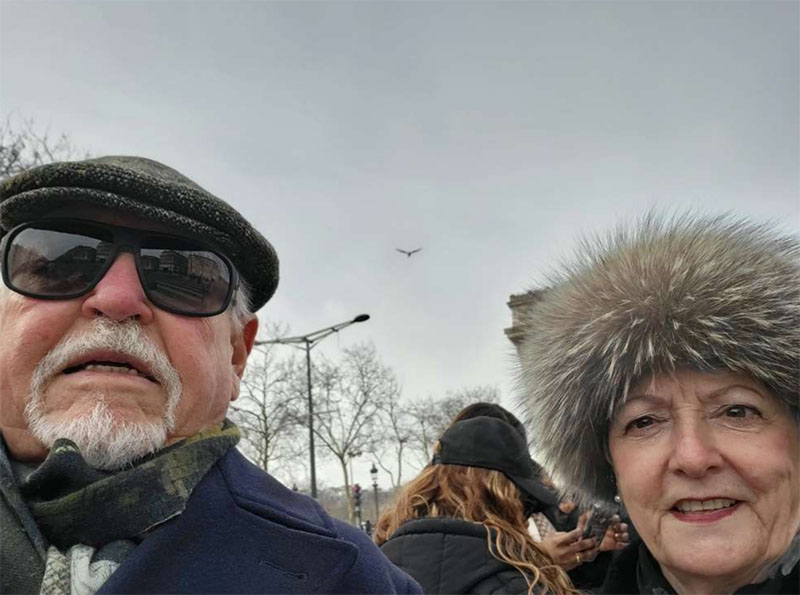
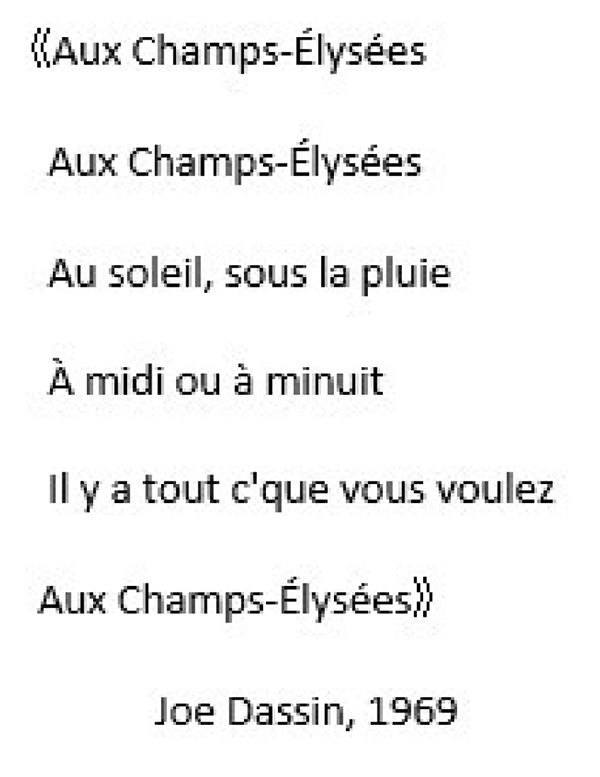
And it’s absolutely true ! There really is everything you want on the Champs-Élysées !
Joe Dassin (November 5, 1938 – August 20, 1980) was an American–French singer-songwriter. In his career spanning sixteen years (1964–1980), he enjoyed numerous successes in France and the French-speaking world, as well as singing in languages other than French. He wrote Aux Champs-Élysées in 1969 and was totally surprised by its success – the music videos have sold over 600,000 copies. Copy and paste the YouTube link below into your browser, then watch and listen to him sing it. I think you will enjoy seeing his charm and vitality as well as hearing him singing Aux Champs-Élysées .
Well, as Porky Pig (and a tip of the hat to Au Cochon Volant and their delicious porcelet) used to say: “That’s all folks!” Just to remind you, I appreciate feedback of every kind. My shameless ego thrives on it. On the other hand, if you are happy just to feed vicariously upon our happy adventures, that is okay too – I don’t need any encouragement to inflict another ediƟon on you at the end of March (en français, mars) in avril’s Fascicle 4.
À bientôt !
 La Vie de Montpellier
Leave a comment