12-14 March – All About Arles
(Tout savoir sur Arles)
Six centuries before the Common Era Greek merchants from Marseille came up the Rhone to trade with the Gauls and established a merchant town they called Theline on a promontory on the eastern branch of the Rhone where it divides into two mouths (bouches) the eastern branch being the more navigable while the western branch further divides to form the Camargue. The height gave them a commanding view up the valley into the heart of Gaul, the source of all that they had come to trade for. The Greeks, unlike the Romans who came later, were merchants, not conquerors. Some 500 years later the Romans did come, and expanded it into an important colonial outpost they called Arlete. They also built a canal link to the Mediterranean, and a coliseum and theater that are still being used today. The see (bishopric) of Arles was established in the first century Common Era by its first Bishop, Trophimus for
whom its cathedral, built between the 12th and 15th centuries was named.
Because the Camargue is administratively part of Arles it is the largest commune in terms of total area in Metropolitan France -seven times larger than Paris!
(But the commune of Arles has a total population of only around 50,000.) Arguably Arles most famous resident has been Vincent Van Gogh, From February 1888 to May 1889 – barely 15 months – he produced 187 paintings and drawings of the over 2,000 artworks he produced in his lifetime; among them Starry Night and the Sunflowers paintings. While you see reminders of his time there everywhere you go in Arles, none of his work is there.
Okay, with that (for me) brief account of the history of Arles, this is where the reading stops and the pictures begin:
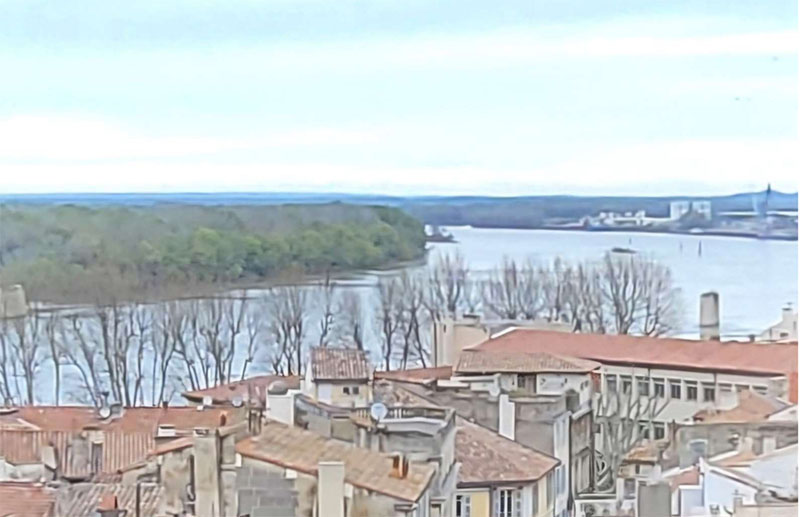
The Rhone valley from the Coliseum in Arles. Just behind those trees on the opposite side is where the river divides.
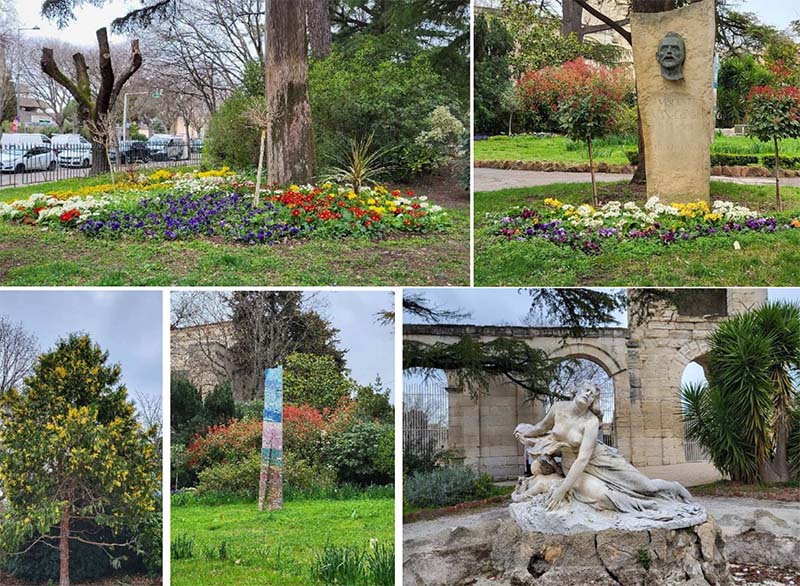
Le Jardin de été (the summer garden) on Boulevard des Lices & the entrance to Le Théâtre antique (Roman Theater)
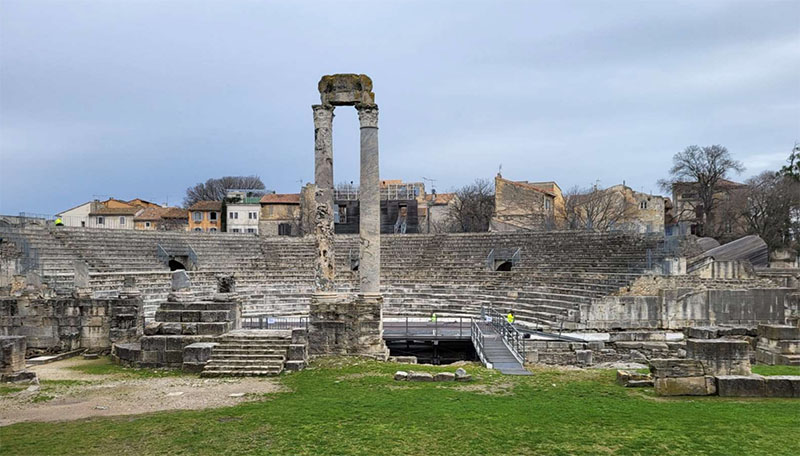
Le Théâtre antique is still being used for performances during the summer, and just around the corner from …

the Amphitheater, or coliseum, which is still being used for bullfighting performances. Both are major Arles tourist attractions. (In France the bullfights do not end with the bull being killed.)

Views around, in, and from the Amphitheatre (Coliseum) seating capacity: 20,000, built circa 90 CE under Vespasian.
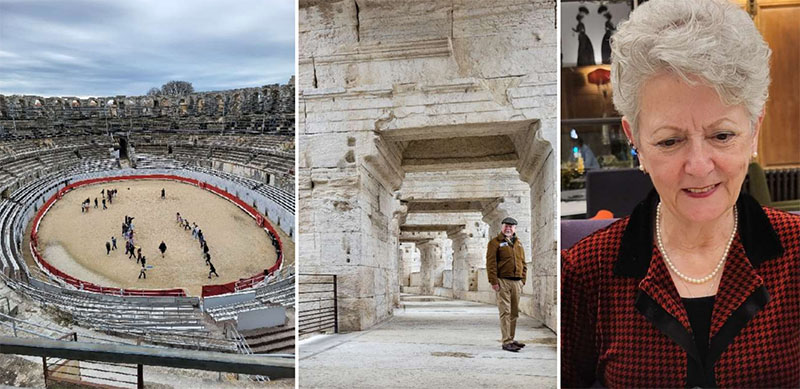
Future gladiators in training, Antique tourist attracted to Arles, and an Attractive tourist attracted to Arles

Even though Arles wasn’t sunny while we were there, there were flowers in bloom everywhere we went.
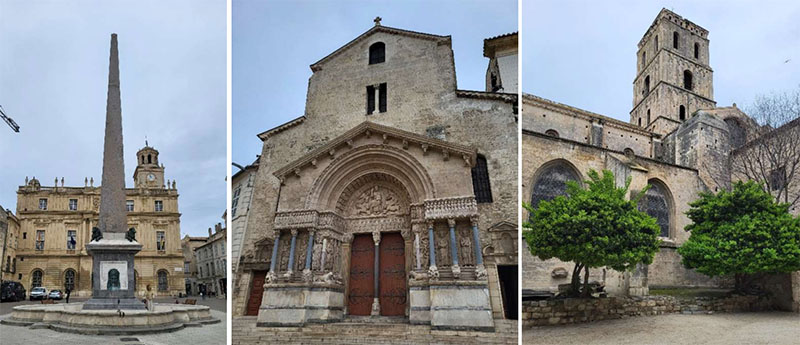
Place de la République is dominated by Hôtel de Ville and Cathédral Saint-Trophime d’Arles and its cloître (cloister)
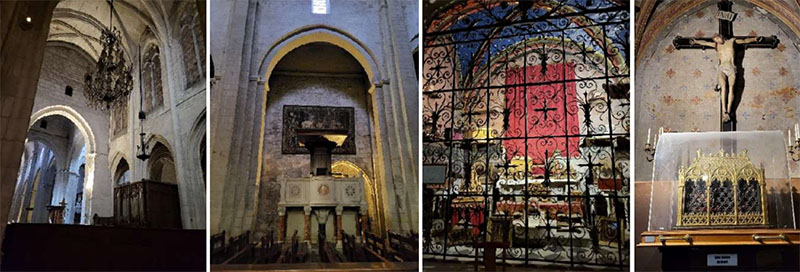
Unlike the Gothic style of Notre-Dame de Paris, the Romanesque style of Saint Trophime is quite dark.
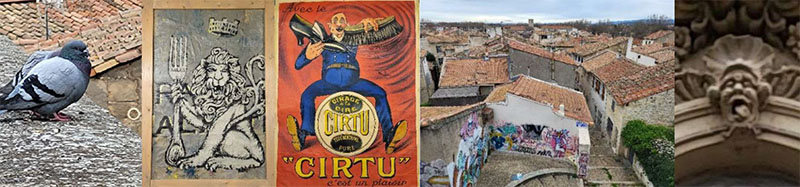
Arles has a whimsical side. Pigeons everywhere scouting for a crumb or two of croissant — antique posters offering everything from soup to shoe polish — graffiti in a courtyard — this keystone that seems to be saying “Assez !”.
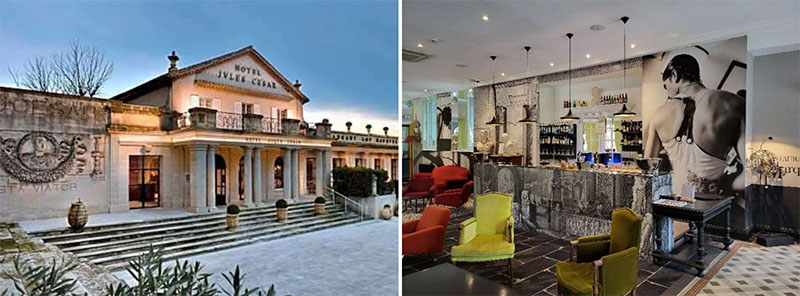
Originally a Carmelite Convent, (above) our hotel’s interiors were designed by Christian Lacroix, and his sense of style permeates everywhere. No aspect was overlooked. Our traveling companions remarked it deserves its 5 stars.
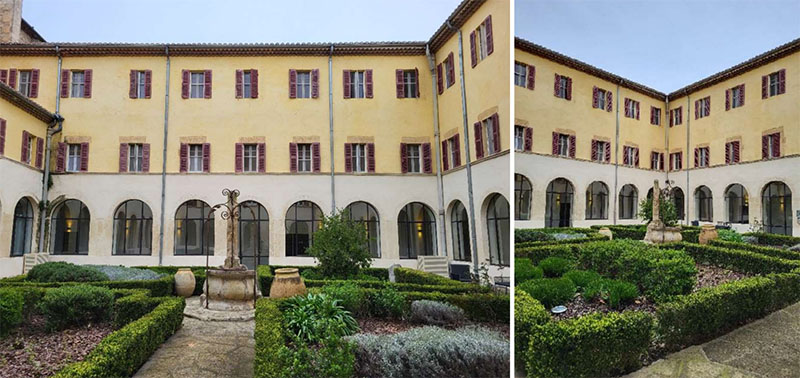
The Convent’s former cloître (cloister) has been transformed into a quiet retreat for hotel guests.
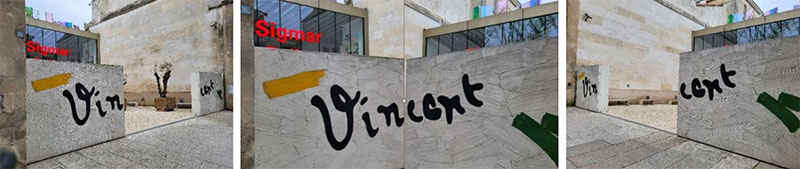
No original works of Vincent Van Gogh remain in Arles, but the Foundation Vincent Van Gogh keeps his memory alive with this gallery that exhibits the work of contemporary artists who carry on his spirit. The yellow house helived in and the café he painted are both gone; but Le Jardin de le Maison de Sante, where he stayed to recover after he had mutilated himself by cutting off his ear, remains. On the left below is a copy of one of the two paintings he made of it. In my photo you can see how little it has changed. We hope to return to Arles again. There is so much there we have yet to explore. As promised, this edition is all about Arles – nothing else. There were more escapades, but not to bore you, this time I’ve decided on just this single subject: Arles.
I always appreciate hearing from you, and enjoy your comments (I even welcome criƟcism). But if you just enjoy reading about our happy adventures, I’m happy with that – my pleasure comes from making these reports, and I don’t require any encouragement to prepare the next edition for you at the end of April (en français, avril) in mai’s Fascicle 5.
À bientôt !
 La Vie de Montpellier
Leave a comment