3 September – Domaine L’Oulivie Revisited

Maybe you remember that this means a bus to the end of the line, a stroll toward Pic Saint-Loup, and into vineyards,
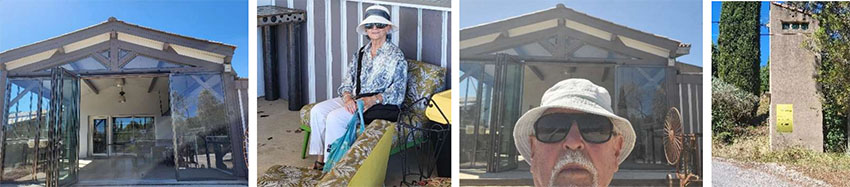
but it was all worth the effort to have a new supply of Picholine and Lucques olive oils. (We took an Uber home.)
5-7 September – La Grande Motte
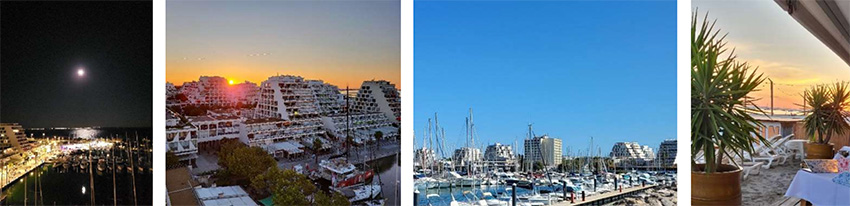
About the only thing nicer than seeing the full moon over La Grande Motte is watching the sun rise over it, and just spending the day enjoying it until the sun begins to set – then doing it again the next day! Last 2025 beach retreat?
30 September-1 October – La Dordogne – Le Périgord-noir et Rocamadour
You may recall my deciding to delay this month’s La Vie until after this tour, which turned out to be one of our best experiences in France so far. The weather, the accommodations, and the tour itself were spectacular – worth all the hours it took geƫting there and returning on trains (9 hours there and back) Uber (at night to our hotel $63) taxi (at noon from hotel to le gare $12) and bus (2 hours because train service interrupted for line repairs). So I hope you will like these photos of our experiences.

The lobby of Hôtel Plaza Madeleine in Sarlat was impressive, much like these rock shelters where the Cro-Magnon lived in the valley of the Vézere some 35,000 years ago. A sculpture represents them. Here we are with him. On the far right, a 1935 FIAT “Balilla” roadster (same vintage as me) parked outside Hôtel Plaza Madeleine.
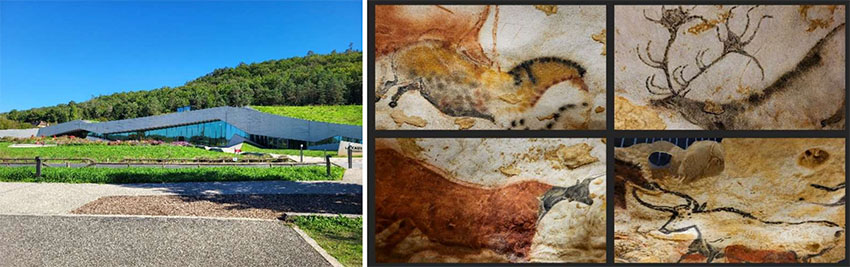
On the left is Lascaux 4 that opened in 2016 to house the recreation of the original cave with its art created 21,000 years ago by the Cro-Magnon (Homo Sapiens Sapiens). It took them about 500 years to create this art. The original cave is now closed because the surfaces supporting the art were deterioraƟng due to the CO2 in the breath of the visitors after it had been opened to the public in 1948. The cave was discovered in 1940 by a teen-age boy, but kept secret during WW2. Lascaux 2 is a smaller museum and Lascaux 3 is a touring exhibition. Lascaux 4’s recreation contains 90% of the original works faithfully reproduced using the original red and yellow ochre and powdered black magnesite pigments applied to the recreated cave surfaces as seen in the collage on the right.
The works themselves aren’t just paintings; the artists used the contours of the surface to add a three dimensional quality, and they engraved lines into the surface so that when illuminated by their lamps it created the illusion of movement. The animals depicted are almost always either horses, aurochs (the ancestor of today’s caƩle, but they were much larger) bison and reindeer. Other animals were rarely depicted. But there are also enigmatic geometric symbols intermingled
among the animals. Lascaux, arguably the best known is but one of over fifty caves containing art so far found in France; some older than Lascaux. The Cro-Magnon did not live in these caves, they lived in the near-by rock shelters, the caves were only used for making this art. Why they did it can only be speculated – it will always remain mysterious.
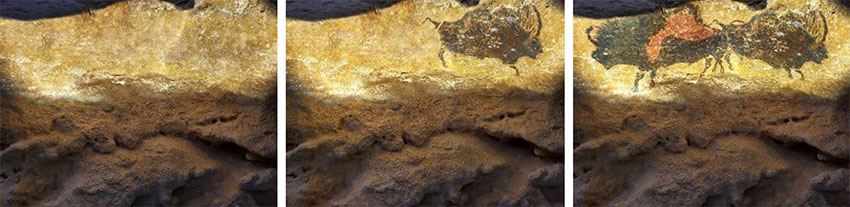
Three photos of the same surface under different intensities of illumination. Under high illumination the images can only be faintly seen, but with decreasing light, first the right image appears (center) and then the bison on the left.
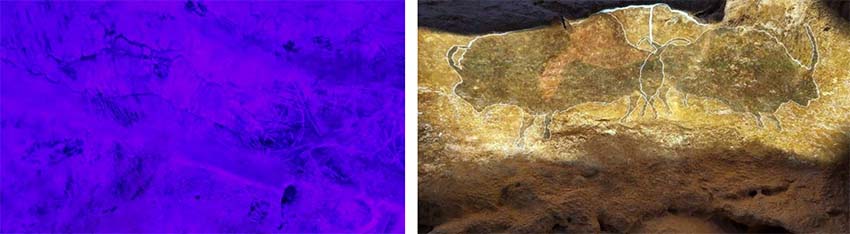
Two examples of engraving: on the left they are only barely visible; on the right they have been used to enhance the images. When the light level varies (as it would in the flickering light of an animal fat lamp) the animals seem to move, an effect the artists were, almost without any doubt, aƩempƟng to create – 21,000 years ago!
30 September – Rocamadour
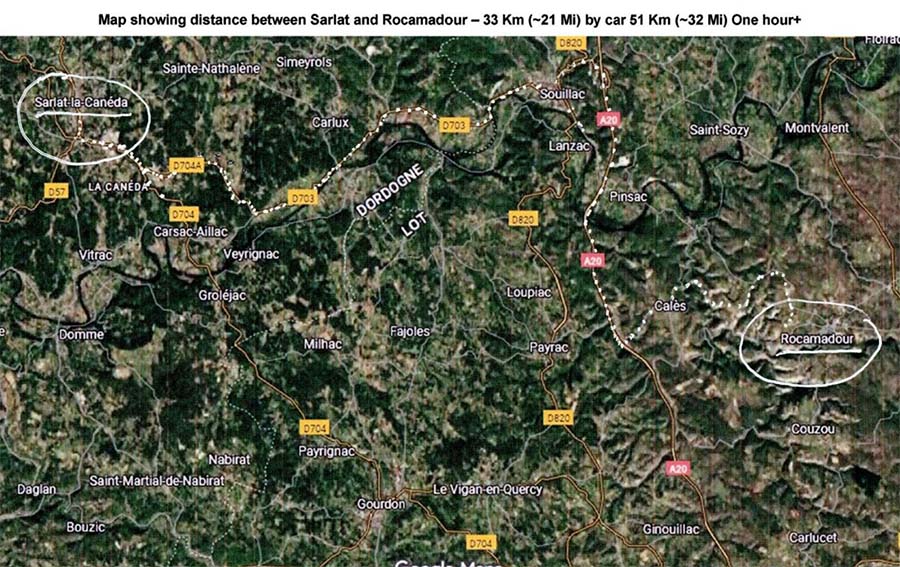
Rocamadour is in the Department to the east of Dordogne, Lot. Our drive there was in a thick fog all the way until we reached a plateau where we could look back and see Rocamadour clinging to the side of a cliff facing south and overlooking L’Alzou valley. In 1166 when a grave was being prepared in front of a chapel dedicated to Notre Dame the corpse of Saint Amadour was discovered and he looked as if he had just died! (Today only a few bones remain as the body was burned in the wars of religion between 1562 and 1598.) Rocamadour became and continues to be one of
the points on the Camino de Santiago de Compostela. Pilgrims descend to the bottom of the gorge and then ascend the 218 step on their knees offering prayers to the Black Madonna in the Basilica Saint Sauveur.

But despite its religious significance, we skipped ascending on our knees for a more gastronomic pilgrimage – the eponymous locally made fresh chevre made from raw goat milk. For me, as divine an experience as anything on earth. Unfortunately the only “taste” I can share are these few pictures below from our all too brief visit there:

(L-R) View from across the valley; our guide, Lena, on the Way of the Cross path; the Fig Gate; the town from above; detail of typical “visage” corbels below window sills; detail of an unpreserved fresco (above) entrance to chapel.
1 October – Sarlat-Domme-La Roque-Beynac
Wednesdays in Sarlat are marchés – market days; and in the oldest parts of the city the streets and squares are lined with stalls selling everything imaginable, mostly made by local arƟsans, and also lots of imported wares – very festive!
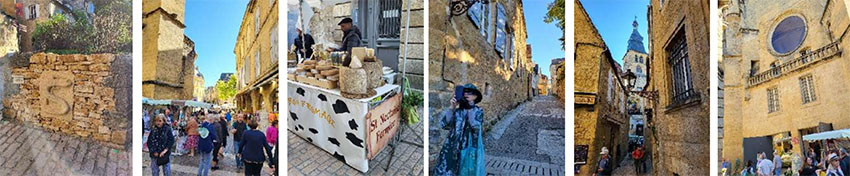
(L-R) The salamander is iconic in Sarlat; streets are crowded; stall selling fromage; Bonny taking a photo; of the salamander atop Cathédrale Saint-Sacerdos; and a deconsecrated church that has been re-purposed as a market.
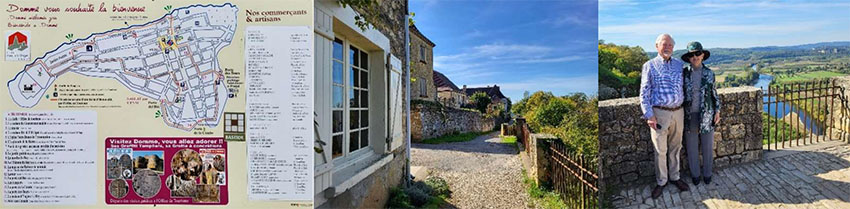
Domme is one of the 180 “Les Plus Beaux Villages de France, founded by King Philip III (“The Bold”) in 1281 as a bastide on top of a plateau overlooking the Dordogne valley; and here we are on one of Domme’s ramparts.
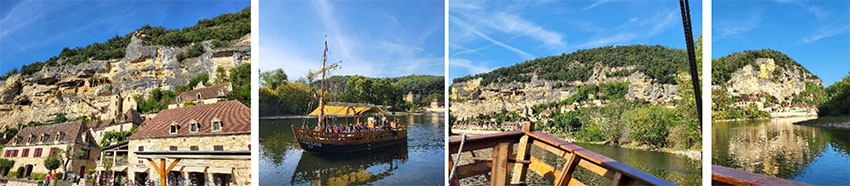
La Roque-Gageac, on the Dordogne downstream and around that bend you see behind us, was one of the ports when river traffic flourished before the coming of the railroads in the 19th century. One of the 180 villages, today it is virtually uninhabited due to the recent rockfalls making it too high a risk. You can see evidence of that above.
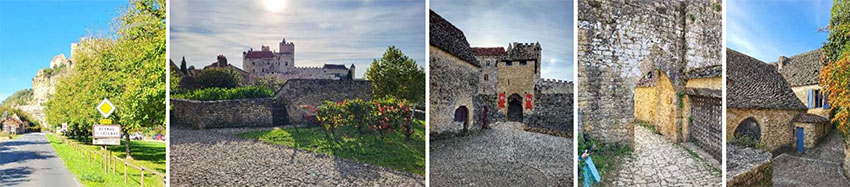
Beynac, another of the 180 villages, and down the Dordogne from La Roque, is a virtual visit to the Middle Ages. The path from its Chateau down to the car park was not for the faint of heart or unsteady of feet – and the conclusion of our tour of the Dordogne!
À bientôt !
John
 La Vie de Montpellier
Leave a comment