Barcelona – 17-20 October
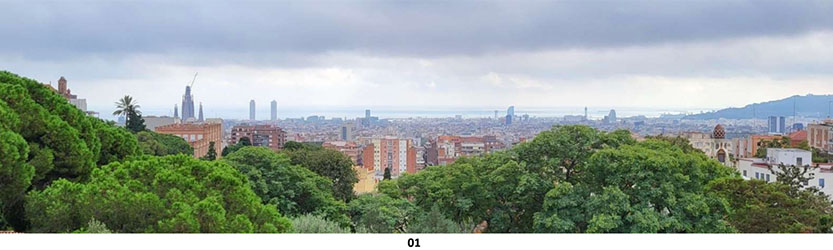
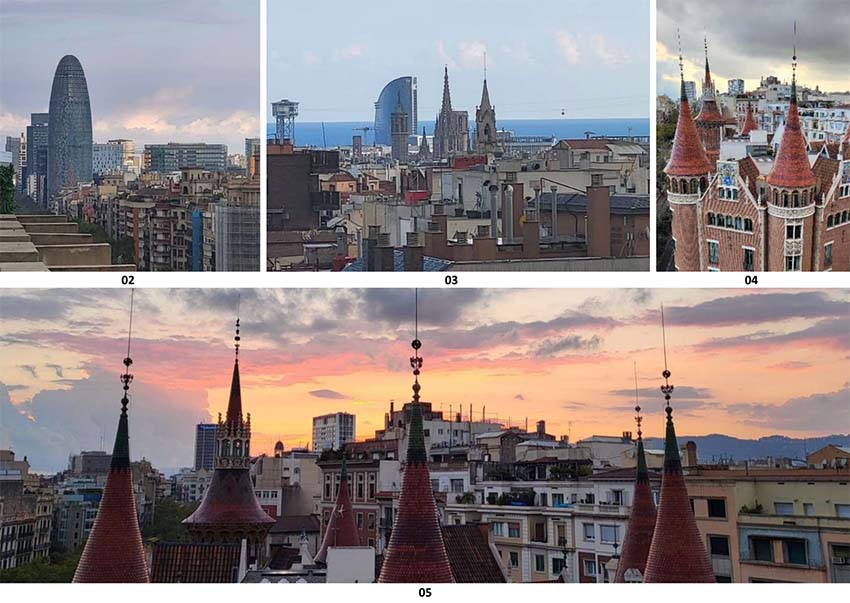
Barcelona from Park Guell (01) or from the terrace at the top of the Occidental Diagonal 414 hotel (02-05) takes your breath away. Its beginnings go back over 5,000 years before the Roman colony, Barcino, was established around 218 BCE, but legend has it that it was founded when Hercules and Jason with a fleet of nine ships were searching for the golden fleece when a storm came and the ninth ship was wrecked here. Its crew was so taken by the beauty of the area that they founded a city and named it Barca Nona (Ninth Ship) A population of 1.5 million, it is the second largest city in Spain and capital of the autonomous region of Catalonia. The Catalan language is used in addition to
Spanish. A major Mediterranean seaport, it hosts cruise ships and yachts as well as commercial freighters from around the world. It’s called the “Manchester of the Mediterranean” because it is a major manufacturing center. It is also a major education and sport center. All this has led it to become one of the top tourist attractions in Europe. Antonio Gaudi’s Sagrada Familia attracts over 5 million annually, more than the Eiffel tower in Paris! Once surrounded by walls (the remnants of which can be seen in the Gothic Quarter) the Eixample district, where Sagrada Familia is located, began in the 1860s. Today Barcelona is a city of many parts – the next pages show some of what we saw.
Gastronomic Barcelona
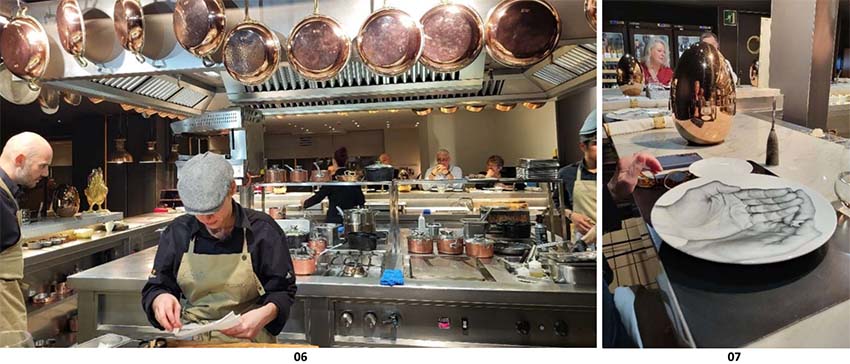
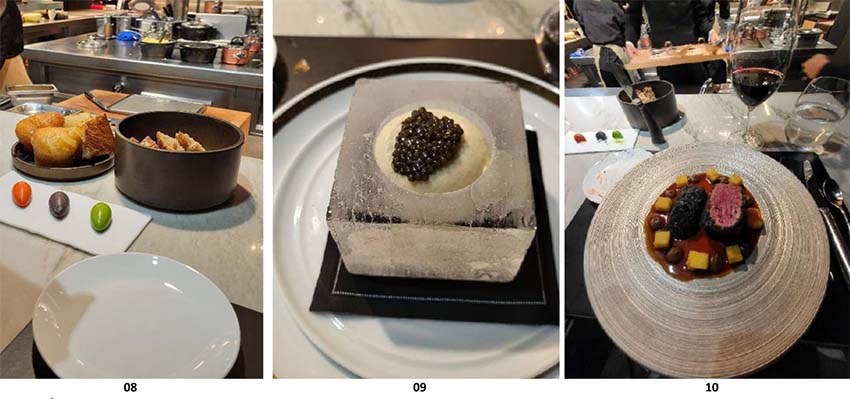
Our wedding anniversary at Michelin starred Caelis. We sat looking into the kitchen (06) each charger had a unique image of a pair of hands and the silverware was kept in that golden egg with Bonny’s reflection (07) the artisanal breads were served with ovals of tomato, black olive, and rosemary butters (08) the first course was vichyssoise foamed into a hollow in a cube of ice and garnished with caviar (09) Our main course was grilled tenderloin encrusted with charred mushrooms and garnished with cubes of potato and dots of chestnut puree and Priorat red wine reduction. (10) We began with flutes of Cava (We’re in Spain!) accompanied by three amuses bouches – over the top!
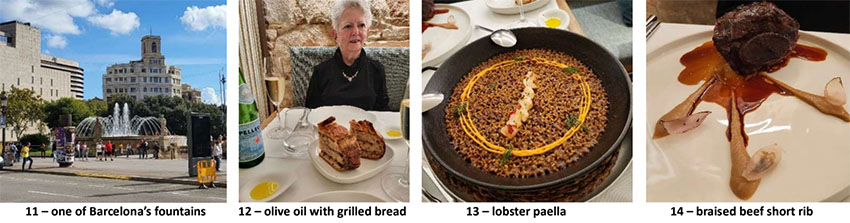
Walking about makes you hungry! (11) Our Sunday dinner at Casa Amalia was equally amazing and delicious! (12, 13, 14)
18 October – Park Guell
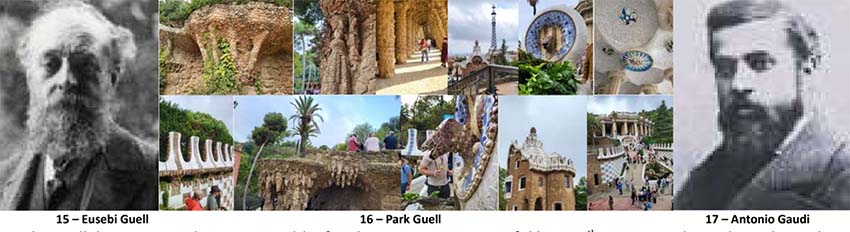
Eusebi Guell, born in Barcelona to a wealthy family, was a very successful late 19th Century industrialist, who in the course of his business frequently visited England where he became interested in the “garden city” concept (the precursor to the 20th century suburbs that surround most major cities) where families of wealth could live on mini-estates surrounded by gardens.
He decided he would bring this concept to Barcelona, and purchased a large tract of land overlooking the city with the intention of developing it into a prestigious neighborhood for Barcelona’s wealthy elite. To that end he hired Antonio Gaudi to design and build a park that would be the centerpiece of the development to attract buyers for the estates surrounding the park – and thereby recoup his investment with a handsome return on it. He gave Gaudi a free hand to realize his vision.
Gaudi’s vision was equally grand: his guiding principle, here as in Sagrada Familia, was nature. He believed that all forms should be guided by those found in the natural world; thus columns lean as trees lean, plants and animals are integrated into everything.
Gaudi was also a genius in harnessing the forces of nature – Barcelona’s intense summer heat, occasional torrential rain storms and violent winds – and creative use of materials that would have otherwise ended up in landfill – the broken shards of ceramic tiles available for the taking from Barcelona’s tile factories – is
seen everywhere in Park Guell.
Well, the larger world played its hand. Only one of the mini-estates was sold. The wealthy elites of Barcelona chose to stay in the city as the belle époque drew to a troubled close. Labor unrest locally, financial panics in Spain and elsewhere, and possible war made the wealthy nervous. The times caught up with Eusebi Guell’s dream. But his loss is the world’s gain – he gave Gaudi’s masterpiece – Park Guell – to the City of Barcelona, to the world, and to you.
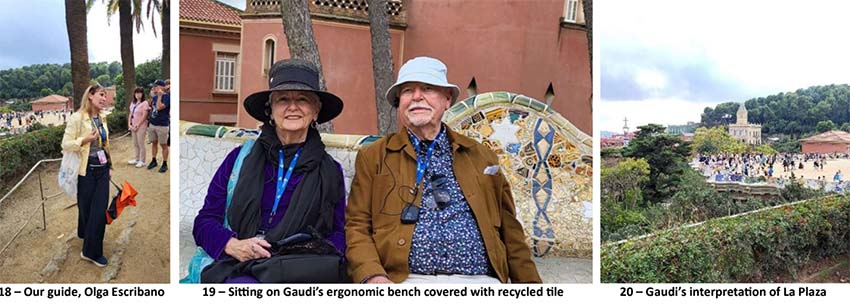
The best way to experience Park Guell today is by a guided tour. Our guide (above) was extraordinary: a native Barcelonina, and fluent in English, without her we would have not been able to discover the history of Park Guell, and Gaudi’s genius, like his use of recycled materials, his profound respect for both nature and traditions. Here, as in Sagrada Familia, his work shows how far ahead of his time he was. The bench we are sitting upon is in the background of the photos to the left and right of us. Throughout Catalonia, and in most Mediterranean cities, where typically you will find a central square with a church, city hall, and cafes and shops between the streets leading into it. Gaudi made this one for Park Guell – but this Plaza is on top of a covered market – that is on top of a cistern that
holds the rainwater that falls on the La Plaza! The surrounding benches are ergonomic and very comfortable.
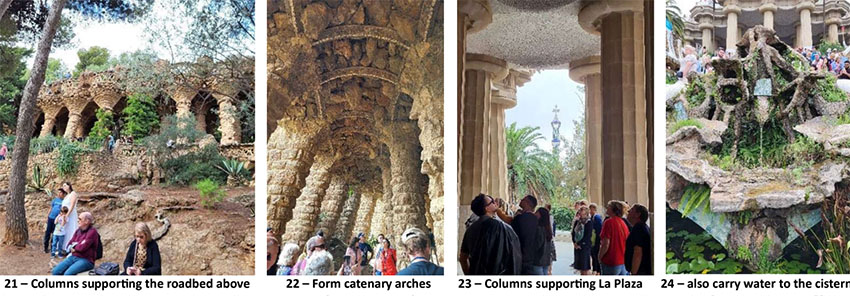
The columns above, mimicking the leaning of the trees, form catenary arches to carry the load of vehicular traffic on the road above them. The use of this arch type, often found in nature, is the strongest. The columns in the market supporting La Plaza create a cool shaded place for the intended market protected from the rain and the scorching Barcelona sun in summer – but also contain conduits that carry the rainwater that falls on La Plaza to the cistern below the market itself. Because rain can at times be torrential, Gaudi provided an overflow outlet for the cistern
that discharges through the mouth of Saint George’s (Barcelona’s patron saint) dragon.
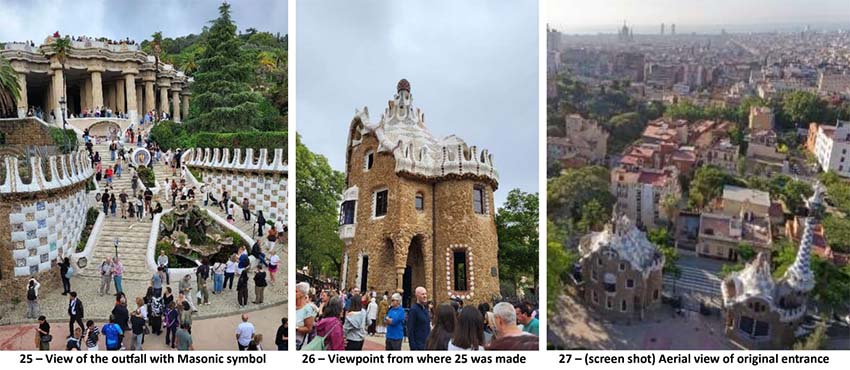
Eusebi Guell and Antoni Gaudi were, as many have been before and since, aware of the significance of the Masonic secret society and chose to recognize it by subtly incorporating its ruler and compass iconography into the space between the steps beside the outfall that lead to the market place and to La Plaza above it. Because of the high volume of tourists that come today, this is no longer used as Park Guell’s main entrance. Nevertheless, one can imagine what an impression it must have made upon those who came to see this in the Belle Epoque, when cars were in their infancy, electricity and the telephone were the newest technologies, and photography wasn’t just another app on a cell phone.
19 October – Sagrada Familia
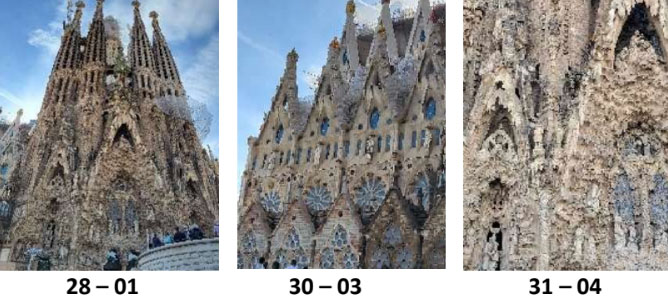
Work began in 1882, but Francisco de Paula del Villar’s design was abandoned, and in 1883 Antoni Gaudí took charge.
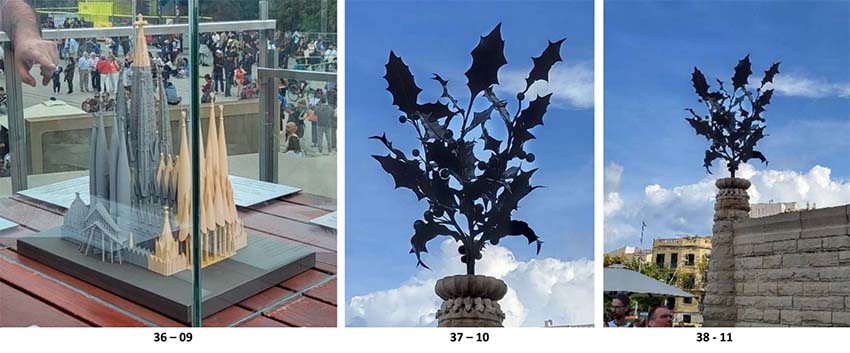
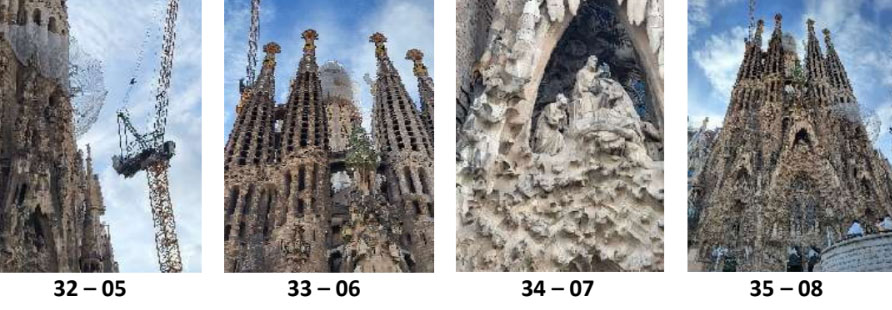
Gaudi took the design of Sagrada Familia in an entirely new direction; abandoning del Villar’s neo-gothic design and creating an entirely new idea, based upon the principles found in nature in both form and detail and always incorporating and expressing the essence of the true meanings of the Roman Catholic church and Christianity. The model of Sagrada Familia in (36 – 09) above illustrates the organic nature of the completed structure; Photos (37 – 10) and (38 – 11) duplicate in bronze the rich, symbolic detail of the holly in detail and in context. The photos above– (28 – 01 through 35 – 08) – show additional examples and the fact that Sagrada Familia remains a work in progress. From the very beginning Sagrada Familia has been financed solely by voluntary contributions. It is not Barcelona’s cathedral (that is in the Gothic Quarter inside the old city) In 2010, Pope Benedict XVI consecrated the Basilica for religious worship and designated it a minor basilica. It has also been designated a world heritage site.
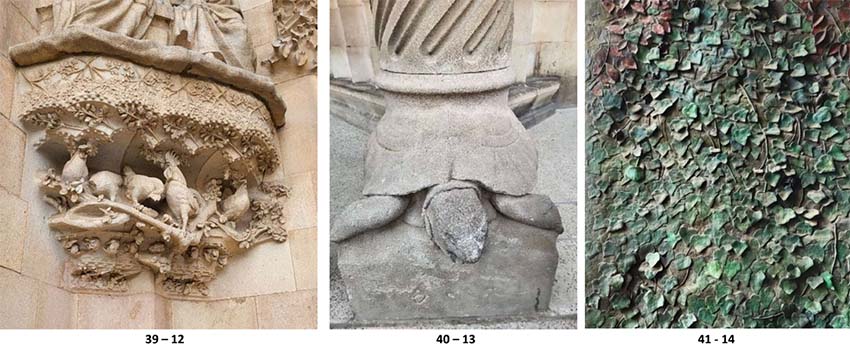
More examples of natural realism in stone and bronze illustrating the richness in the details everywhere you look.
Sagrada Familia is impossible to capture in its entirety in a few pages of pictures and text. Rather than even
attempting to do that, I’ve decided to add just one more page of photos, and then move on. The photos on the next page will give you some examples of how Gaudi used both natural and artificial lighting to create an experience of radiance that is arguably unequalled anywhere, and at the same time capturing a rich religious feeling.
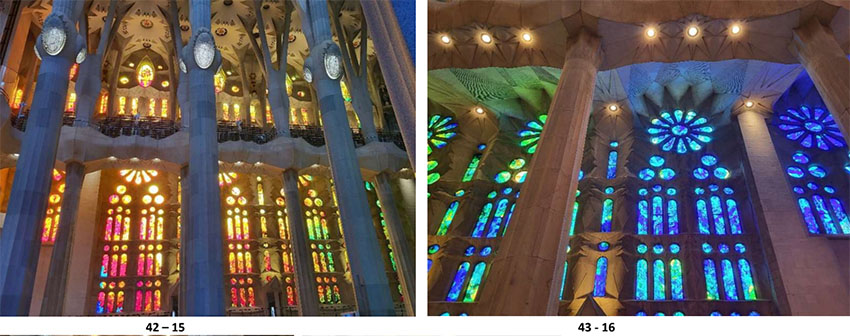

20 October – Gothic Quarter

where beasts of all kinds are everywhere. These improbable beasts (47 and 48) reassuringly are on guard around the apse of the cathedral. Elsewhere these stone birds attacking a turtle are embedded in one of the ancient walls.
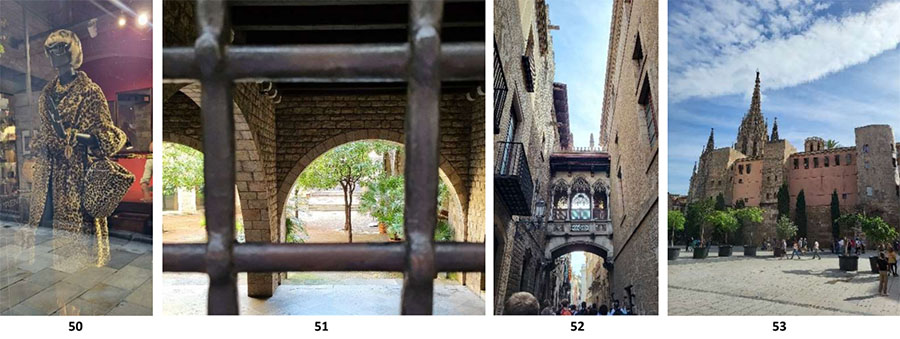
Fierce (but faux) furry creatures, mysterious barred courtyards, bridges – and then the Cathedral of the Holy Cross and Saint Eulalia – La Seu – appears before you in La Plaza. But before I finish I want you to know that should you decide to visit Barcelona, these “ angels will be watching over you.
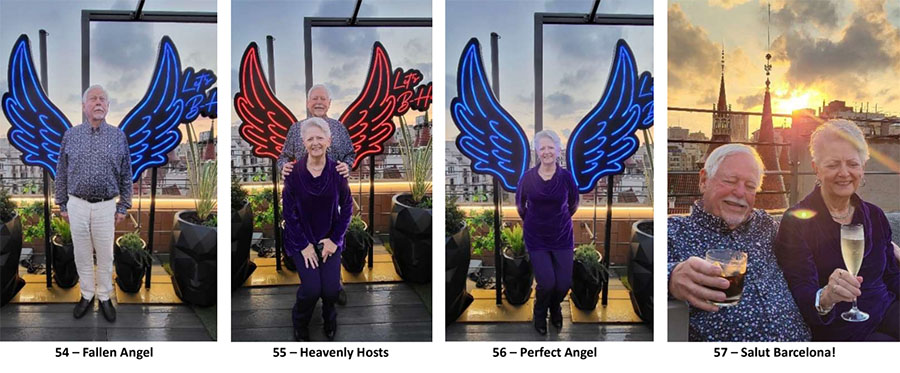
I hope you have enjoyed this quick tour of Barcelona in photos. If you haven’t been there, maybe this will make you decide to put it on your own “bucket list”, and if you have been, maybe this will make you decide to go again. I know both of us hope to go again someday. We know we have not seen many of Barcelona’s many other attractions: Museo Picasso, the harbor area, Mont Juic, and Fundacio Joan Miro – to name only a few.
À bientôt !
John
 La Vie de Montpellier
Leave a comment